
- This topic is empty.
-
AuthorPosts
-
2026-05-18 at 16:36 #123247
In modern transmission systems, gear performance is no longer defined solely by material strength or basic machining accuracy. Instead, micro-level geometry, surface integrity, and meshing behavior determine efficiency, noise levels, and long-term durability. The worm grinding machine has become a critical piece of equipment in achieving these performance targets, especially for hardened gears used in automotive, aerospace, robotics, and heavy industrial applications.
Unlike traditional finishing methods, worm grinding is designed to deliver consistent micron-level accuracy across large production volumes. It enables manufacturers to control tooth profile, lead, and surface roughness simultaneously, ensuring stable meshing characteristics under dynamic load conditions.
Wuxi General Machinery Co., Ltd., with its comprehensive portfolio of CNC gear cutting and grinding equipment, provides integrated solutions that bridge rough machining and ultra-precision finishing, allowing manufacturers to streamline production while maintaining high quality standards.
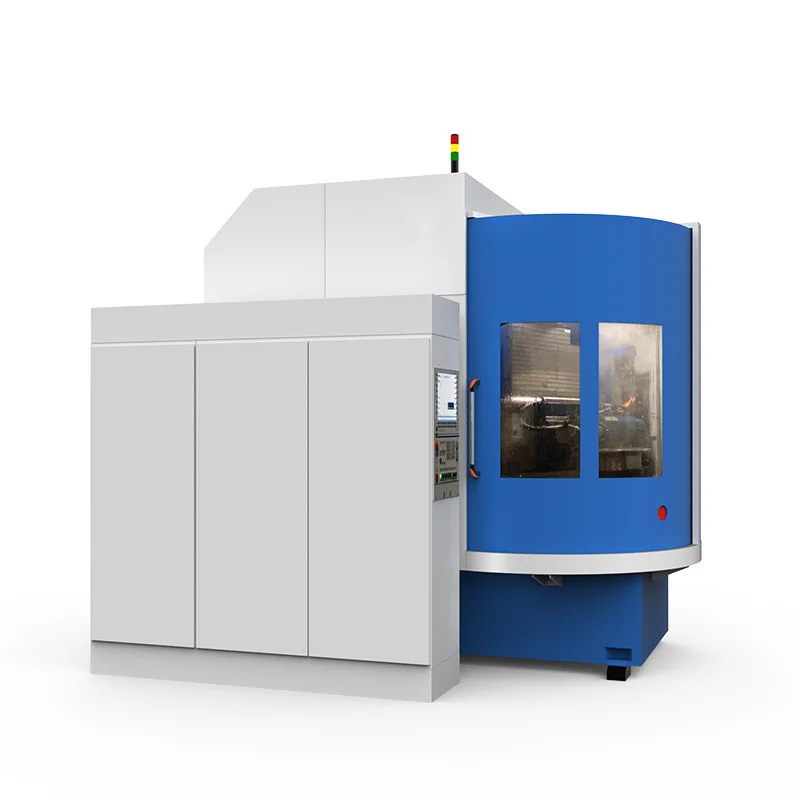
The Role of Worm Grinding in Modern Gear Production
Gear manufacturing typically involves multiple stages, including hobbing, shaping, heat treatment, and finishing. After heat treatment, gears undergo dimensional distortion and surface hardening, making precision finishing essential. This is where the worm grinding machine becomes indispensable.
By using a continuously rotating abrasive worm that simulates real gear meshing, the process achieves a generating grinding action. This allows for simultaneous correction of profile deviations and pitch errors introduced in earlier stages. The result is a gear with significantly improved contact pattern, reduced transmission error, and enhanced load distribution.
In practical terms, worm grinding enables manufacturers to reach accuracy levels equivalent to DIN 4–6 standards while maintaining surface roughness in the range of Ra 0.4 to 0.8 μm. These values directly translate into quieter operation and longer service life, particularly in high-speed or high-load environments.
Key Technical Characteristics That Influence Performance
The effectiveness of a worm grinding machine is largely determined by how well its mechanical structure, spindle system, and CNC control work together. Grinding accuracy is not only a function of machine precision but also of thermal stability and dynamic stiffness during operation.
Modern machines are typically equipped with high-speed grinding spindles operating between 3,000 and 8,000 RPM, supported by high-precision bearings to minimize runout and vibration. This allows stable material removal even when working with hardened steels above HRC 58. At the same time, multi-axis CNC systems—commonly configured with five or six interpolated axes—enable precise synchronization between the grinding worm and the workpiece.
The ability to control parameters such as feed rate, grinding depth, and dressing cycles in real time is critical. For example, maintaining a grinding depth within 0.01–0.05 mm per pass ensures a balance between productivity and surface integrity, while feed rates in the range of 0.2–1.0 mm per revolution help prevent thermal damage without sacrificing throughput.
Structural Design and Its Impact on Machining Stability
A high-performance worm grinding machine is fundamentally a system built around rigidity and thermal control. The grinding head must maintain consistent alignment under continuous operation, which requires a combination of high-stiffness materials, optimized structural design, and effective heat dissipation.
The workpiece clamping mechanism also plays a decisive role. Even minor deviations in concentricity—beyond 2 μm—can introduce errors in tooth geometry. Advanced machines use servo-controlled or hydraulic clamping systems that ensure stable positioning throughout the grinding cycle.
Another critical element is the dressing system. Since the grinding worm gradually wears during operation, precise dressing is required to restore its geometry. CNC-controlled diamond dressing rollers enable automatic correction of the grinding tool profile, ensuring consistent output quality without manual intervention.
Process Control and Optimization in Real Production
In industrial environments, achieving consistent quality across batches requires more than machine capability—it depends on process control. Grinding parameters must be adapted based on material properties, gear size, and production volume.
For hardened alloy steels, lower feed rates combined with controlled thermal input help prevent micro-cracks and surface burns. In contrast, softer materials such as cast iron allow higher material removal rates, improving productivity. Stainless steel, with its tendency to retain heat, requires careful balancing of speed and coolant flow to avoid deformation.
Thermal management becomes especially important during continuous production. Temperature fluctuations, even within a few degrees, can lead to dimensional drift. High-end worm grinding machines address this through temperature-controlled coolant systems and real-time monitoring of spindle and machine structure temperatures.
Application-Driven Performance Requirements
The value of worm grinding technology becomes most evident when examining real-world applications. In automotive transmissions, where noise and efficiency are critical, the ability to produce gears with minimal transmission error directly improves vehicle performance. Worm grinding ensures consistent meshing behavior across large production volumes, which is essential for mass manufacturing.
In robotics and automation, the demand shifts toward smaller modules and higher precision. Here, even minor deviations can affect positioning accuracy and repeatability. Worm grinding enables tight tolerance control, ensuring reliable performance in precision motion systems.
Aerospace applications introduce another layer of complexity, as components must meet stringent safety and durability standards. The combination of high-strength materials and complex geometries requires a finishing process that can deliver both accuracy and structural integrity. Worm grinding meets these requirements by maintaining surface quality while minimizing residual stress.
Heavy machinery, on the other hand, demands durability under high loads. Larger gears with wider face widths require stable grinding conditions to ensure uniform contact patterns. The ability of worm grinding machines to handle large diameters while maintaining accuracy makes them suitable for such applications.
Comparison with Alternative Finishing Processes
While several finishing methods are available, worm grinding stands out when precision and consistency are non-negotiable. Gear hobbing and shaping are primarily used for rough machining and cannot achieve the required surface finish for high-performance applications. Shaving improves surface quality but is limited to softer materials and does not provide the same level of accuracy.
Honing offers good surface finish and noise reduction capabilities but is typically used as a secondary finishing process. Worm grinding, in contrast, combines high accuracy with excellent surface quality in a single process, making it the preferred solution for hardened gears.
The difference becomes particularly significant in applications where transmission noise and efficiency are critical. Worm grinding reduces micro-geometry errors, resulting in smoother operation and lower energy loss.
Integration with Automation and Digital Manufacturing
As manufacturing moves toward Industry 4.0, worm grinding machines are increasingly integrated into automated production lines. Robotic loading systems reduce manual handling and improve cycle consistency, while automatic tool changers enable uninterrupted operation.
Digital monitoring systems provide real-time data on machine performance, tool wear, and process parameters. This allows operators to make adjustments proactively, reducing the risk of defects and unplanned downtime. In-line measurement systems further enhance quality control by enabling immediate feedback and correction.
Such integration not only improves productivity but also ensures traceability, which is essential in industries with strict quality requirements.
Cost Efficiency and Long-Term Value
Although worm grinding machines require higher initial investment compared to conventional finishing equipment, their long-term value is evident in reduced scrap rates, lower rework requirements, and improved product quality. High-precision gears result in fewer warranty issues and longer service life, which directly impacts the total cost of ownership.
From an operational perspective, the ability to combine multiple finishing objectives into a single process reduces production complexity. This leads to shorter lead times and more efficient use of resources. Over time, these advantages outweigh the initial equipment cost, making worm grinding a strategic investment for manufacturers aiming to compete in high-end markets.
Wuxi General Machinery: Integrated Gear Manufacturing Solutions
Wuxi General Machinery Co., Ltd. has built its expertise around providing complete gear manufacturing solutions, covering the entire process from cutting to finishing and measurement. Their worm grinding machines are designed with a focus on precision, stability, and adaptability, allowing manufacturers to handle a wide range of gear types and production requirements.
By integrating CNC technology, advanced control systems, and robust mechanical design, Wuxi General Machinery enables customers to achieve consistent quality while optimizing production efficiency. Their ability to provide end-to-end solutions simplifies equipment selection and ensures compatibility across different stages of gear manufacturing.
Conclusion
The worm grinding machine is a cornerstone of modern gear manufacturing, enabling the production of high-precision, high-performance gears required in advanced industrial applications. Its ability to deliver superior accuracy, surface finish, and consistency makes it indispensable in sectors where reliability and efficiency are critical.
By combining advanced CNC control, optimized process parameters, and robust machine design, manufacturers can achieve significant improvements in product quality and operational efficiency. Investing in worm grinding technology is not just a step toward better machining—it is a strategic move toward long-term competitiveness in precision engineering.
http://www.gltmachinery.com
Jiangxi BonSure Technology Co. , Ltd. -
AuthorPosts

- You must be logged in to reply to this topic.