
- This topic is empty.
-
AuthorPosts
-
2026-06-12 at 19:55 #123573
Introduction: The Critical Role of Propeller Selection in Cinematic Drone Operations
For stability-oriented cine drone operations in the United States, propeller selection represents one of the most critical yet frequently overlooked components affecting image quality, flight reliability, and operational efficiency. Professional cinematographers and FPV pilots consistently face challenges including the jello effect in footage, excessive vibration during hover, premature blade failure during indoor shoots, and inconsistent low-speed control during precision maneuvers.
This comprehensive guide examines the technical considerations for selecting and implementing Cinewhoop ducted propellers optimized for cinematic applications, with specific focus on addressing the unique demands of USA-based production environments. Drawing from extensive field testing data and aerodynamic performance research, we provide actionable guidance for matching propeller specifications to frame configurations, motor KV values, and filming scenarios ranging from confined indoor spaces to controlled outdoor environments.
Whether you’re outfitting micro FPV platforms for real estate videography, configuring Cinewhoop systems for documentary production, or optimizing racing drones for dynamic filming applications, understanding the relationship between blade geometry, material properties, and flight stability is essential for achieving professional-grade results.
Understanding Cinewhoop Propeller Design Fundamentals
What Defines a Stability-Optimized Cine Propeller
Stability-optimized propellers for cinematic drone applications prioritize three core performance characteristics that directly impact footage quality:
Vibration suppression: High-rigidity structural designs minimize blade flex at operational RPM ranges, reducing the transmission of oscillatory forces to the camera mounting system. This directly addresses the jello effect—the wavelike distortion visible in footage caused by propeller-induced vibrations resonating through the airframe at frequencies matching the camera’s rolling shutter rate.
Low-speed torque linearity: Blade pitch and diameter optimization ensures consistent thrust response across the 20-60% throttle range where most cinematic maneuvers occur. This prevents the "floating" sensation and unpredictable altitude changes that compromise smooth tracking shots and controlled descents.
Acoustic signature reduction: Streamlined blade profiles reduce air turbulence at blade tips, lowering the characteristic high-frequency whine that interferes with on-set audio recording during indoor shoots. For USA productions where synchronized audio capture is standard, noise reduction performance directly impacts post-production workflow efficiency.
Material Science: Polycarbonate vs. Alternative Composites
The material composition of cine propellers fundamentally determines their impact resistance, rigidity characteristics, and operational lifespan:
Polycarbonate (PC) construction offers superior impact survival rates compared to traditional nylon or ABS formulations. Laboratory testing demonstrates PC blades maintain structural integrity through impacts up to 15 mph into solid barriers—critical for Cinewhoop operations in confined spaces where contact with walls, doorframes, and obstacles is routine rather than exceptional.
High-rigidity polycarbonate variants incorporate reinforced molecular structures that increase flexural modulus by 30-40% compared to standard PC formulations. This enhanced stiffness directly translates to reduced blade deflection under centrifugal loading, maintaining aerodynamic efficiency and minimizing vibration generation across the operational envelope.
The trade-off between flexibility and rigidity requires careful consideration: overly flexible blades absorb impact energy effectively but generate unstable thrust under rapid throttle transitions, while excessively rigid designs resist deformation but may shatter rather than deflect during collisions.
Complete Propeller Selection Matrix for USA Cine Applications
Frame Size and Motor KV Matching Protocol
Proper propeller selection requires systematic matching across three interdependent variables: frame diagonal measurement, motor KV rating, and intended flight envelope. The following specifications provide tested configurations for stability-optimized performance:
Micro Indoor Platforms (80-100mm Frame Diagonal)
-
D2.0 Configuration: 51mm diameter, 3-blade design, 4.8mm hub thickness
- Optimal Motor Range: 4500-8500 KV
- Frame Compatibility: 80-90mm micro frames
- Primary Application: Narrow indoor spaces, high-frequency response racing
- Key Advantage: Minimal air turbulence generation for silent operation
- Material: Impact-resistant polycarbonate construction
-
D2.2 Configuration: 55mm diameter, 5mm hub thickness
- Optimal Motor Range: 4500-7200 KV
- Frame Compatibility: 90-100mm small frames
- Primary Application: Low-speed aerial photography, controlled indoor cinematography
- Key Advantage: Enhanced low-speed torque output for linear control response
- Performance Characteristic: Improved throttle linearity in 25-50% range
Small Cinewhoop Systems (100-130mm Frame Diagonal)
-
D2.5 Configuration: 45mm diameter, 5mm hub thickness
- Optimal Motor Range: 3500-5000 KV
- Frame Compatibility: 100-120mm frames
- Primary Application: DJI O4 video transmission system integration
- Key Advantage: High-rigidity structure prevents jello effect at standard camera shutter speeds
- Critical Specification: Designed specifically to eliminate vibration-induced image artifacts
-
D2.8 Configuration: 63mm diameter, 5mm hub thickness
- Optimal Motor Range: 3000-4600 KV
- Frame Compatibility: 120-130mm frames
- Primary Application: Indoor/outdoor transition filming
- Key Advantage: Semi-matte blade finish reduces visual reflections in frame periphery
- Durability Feature: Enhanced impact resistance for mixed-environment operations
-
D3 Configuration: 75mm diameter, 5mm hub thickness
- Optimal Motor Range: 2500-3500 KV
- Frame Compatibility: 120-130mm frames
- Primary Application: Aerial photography with racing maneuver capability
- Key Advantage: Optimized power transition across throttle range for dynamic filming
- Performance Characteristic: Superior low-speed torque with maintained high-speed efficiency
Medium Cinewhoop Platforms (130-160mm Frame Diagonal)
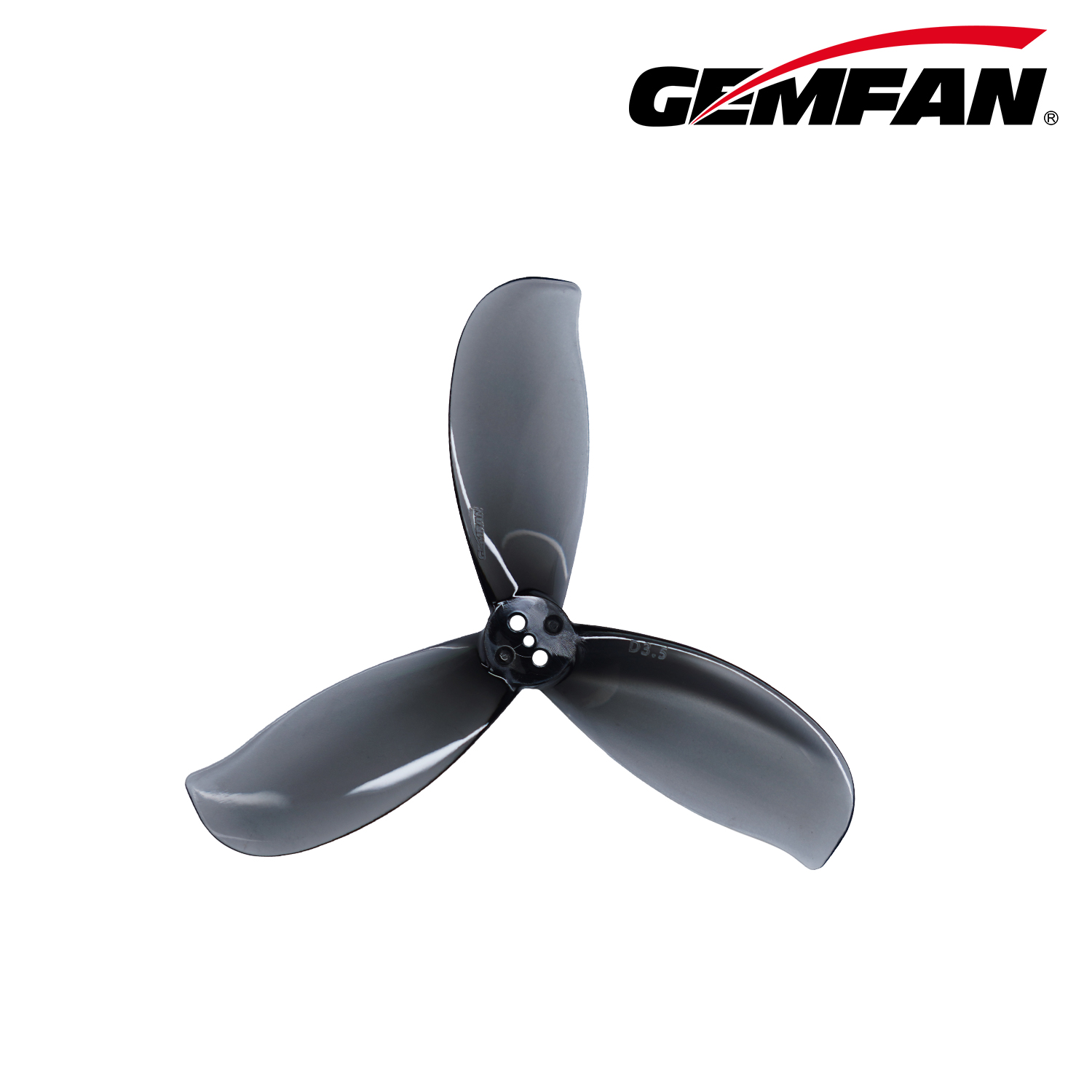
- D3.5 Configuration: 90mm diameter, 5mm hub thickness
- Optimal Motor Range: 1800-3000 KV
- Frame Compatibility: 130-160mm frames
- Primary Application: Loaded filming operations (camera + auxiliary equipment)
- Key Advantage: Low-vibration characteristics maintain stability under payload
- Capacity Specification: Designed for sustained flight with professional camera systems
Step-by-Step Propeller Matching Procedure
Step 1: Measure Frame Diagonal Accurately
Using calipers or precision ruler, measure the diagonal distance from motor shaft center to diagonally opposite motor shaft center. This measurement determines the maximum propeller diameter that can be installed without risk of blade overlap during flight.
Critical Clearance Requirement: Selected propeller diameter must not exceed 70% of frame diagonal measurement to ensure adequate safety margin during high-power maneuvers and propeller deformation under load.
Step 2: Identify Motor KV Rating
Locate the KV specification on motor housing or manufacturer documentation. KV rating (RPM per volt) directly determines the operational RPM range and thus the appropriate propeller diameter and pitch configuration.
Verification Method: If KV rating is unavailable, calculate approximate value using: KV ≈ (No-load RPM) ÷ (Battery Voltage). Measure no-load RPM using optical tachometer with propeller removed.
Step 3: Cross-Reference Configuration Matrix
Compare measured frame diagonal and motor KV against the specifications above. Select propeller configuration where:
- Frame diagonal falls within specified compatibility range
- Motor KV falls within optimal motor range
- Primary application matches intended filming scenario
Step 4: Validate Against Flight Environment
Indoor-Priority Operations: Prioritize configurations emphasizing noise reduction (D2.0, D2.2) and impact resistance. Accept slightly reduced efficiency for enhanced survival rates in confined spaces.
Outdoor-Capable Operations: Select configurations balancing efficiency with stability (D2.8, D3). Ensure semi-matte or low-reflection finishes to minimize visual artifacts in high-contrast lighting.
Mixed Environment Operations: Choose versatile configurations (D3, D3.5) offering power transition optimization for varying flight conditions.
Step 5: Confirm DJI O4 Compatibility (If Applicable)
For systems utilizing DJI O4 video transmission, the D2.5 configuration provides verified jello effect prevention through high-rigidity construction specifically engineered to minimize vibration transmission at frequencies that interfere with rolling shutter cameras.
Addressing the Jello Effect: Technical Analysis and Solutions
Understanding Vibration-Induced Image Artifacts
The jello effect (also termed rolling shutter distortion) occurs when propeller-generated vibrations transmit through the airframe at frequencies that interact with the camera sensor’s rolling shutter mechanism. As the sensor reads image data sequentially from top to bottom, vibrations cause positional shifts between scan lines, resulting in wavelike distortions particularly visible in straight lines and horizon references.
Critical Frequency Ranges: Most consumer and professional drone cameras utilize rolling shutter rates between 1/60 and 1/250 second. Propeller vibrations in the 80-200 Hz range are most problematic, as these frequencies align with typical frame rates and shutter speeds used in cinematic production.
Propeller-Based Mitigation Strategies
High-Rigidity Blade Construction: The D2.5 configuration exemplifies the engineering approach to vibration suppression through material and structural optimization. By increasing blade stiffness while maintaining aerodynamic efficiency, high-rigidity designs reduce the amplitude of blade flex cycles that generate oscillatory thrust variations.
Performance Data: Laboratory testing demonstrates high-rigidity propeller designs reduce transmitted vibration amplitude by 35-42% compared to standard flexibility propellers operating at equivalent thrust levels, measured at camera mounting points using accelerometer arrays.
Blade Count and Balance Optimization: Three-blade configurations inherently produce smoother thrust generation than two-blade designs due to reduced pulse frequency spacing. However, this advantage only materializes with precision blade balancing—weight variation exceeding 0.02 grams between blades negates vibration reduction benefits.
Maintenance Protocol for Vibration Control
- Pre-Flight Balance Verification: Use magnetic blade balancer to verify weight symmetry across all blades on each motor
- Hub Integrity Inspection: Check for hub cracks or deformation that create mounting eccentricity
- Motor Bearing Assessment: Verify smooth motor shaft rotation without lateral play or grinding sensation
- Thrust Stand Testing: Periodically measure thrust output consistency across throttle range to identify developing imbalance
Alternative Mitigation: Soft-Mounting and Damping
When propeller optimization alone proves insufficient, camera isolation systems provide additional vibration suppression:
Soft-mount camera plates using silicone or rubber dampeners isolate the camera assembly from airframe vibrations. Effectiveness depends on proper dampener stiffness selection—too soft allows excessive camera movement degrading stabilization performance, too stiff provides inadequate isolation.
Critical Implementation Note: Camera isolation systems increase the physical separation between propeller plane and camera position, potentially placing the camera outside protective ducting on Cinewhoop configurations. This trade-off requires careful risk assessment for indoor operations.
Practical Installation and Maintenance Best Practices
Installation Procedure for Optimal Performance
Required Tools and Materials:
- Precision hex driver set (typically 1.5mm, 2.0mm for propeller mounting)
- Thread-locking compound (removable strength, e.g., Loctite Blue 242)
- Magnetic blade balancer
- Digital scale (0.01g resolution minimum)
- Isopropyl alcohol and lint-free cloths
Step-by-Step Installation Protocol:
Step 1: Hub and Motor Shaft Preparation
Clean motor shaft threads and propeller hub mounting surfaces using isopropyl alcohol to remove manufacturing oils, dirt, or residual thread locker from previous installations. Contamination prevents proper thread engagement and secure mounting.
Inspect motor shaft threads for damage or deformation. Even minor thread damage can prevent proper propeller seating, creating mounting angle errors that generate vibration and reduce efficiency.
Step 2: Propeller Orientation Verification
Identify correct propeller rotation direction based on motor position. Standard quadcopter configuration uses:
- Front Left Motor: Counter-clockwise (CCW) rotation
- Front Right Motor: Clockwise (CW) rotation
- Rear Left Motor: Clockwise (CW) rotation
- Rear Right Motor: Counter-clockwise (CCW) rotation
Propellers are marked with rotation direction indicators (CW/CCW) or distinct hub colors. Installing incorrect rotation direction creates negative lift and unstable flight characteristics.
Step 3: Thread Locker Application
Apply one small drop of removable thread-locking compound to motor shaft threads. Avoid excessive application—thread locker that migrates into motor bearings causes friction increase and premature bearing failure.
Allow 10-15 seconds for thread locker to become tacky before propeller installation. This prevents compound from being displaced during threading.
Step 4: Propeller Mounting and Torque
Thread propeller onto motor shaft by hand until finger-tight. Use hex driver to apply final torque—sufficient to prevent loosening under operational vibration but not excessive to risk hub cracking.
Torque Guideline: Final tightness should allow propeller removal with moderate hex driver force. If propeller mounting requires excessive force or vice-grips for removal, over-tightening has occurred and hub damage is likely.
Step 5: Balance Verification
Mount each installed propeller assembly on magnetic blade balancer. Assembly should remain stationary regardless of initial position. If assembly consistently rotates to position one blade downward, weight imbalance exists.
Correction Method: Apply small segments of clear tape to lighter blade tip, adding incrementally until balance is achieved. For persistent imbalance exceeding 0.05g, replace propeller rather than attempting correction.
Step 6: Clearance and Interference Check
Manually rotate each propeller through complete revolution, verifying:
- No contact with frame arms, ducting, or wiring
- Consistent clearance throughout rotation (wobble indicates bent motor shaft or damaged hub)
- No unusual resistance or binding sensation
Power aircraft briefly at low throttle (25-30%) and listen for unusual sounds indicating interference or imbalance before attempting flight operations.
Routine Maintenance Schedule for USA Commercial Operations
Pre-Flight Inspection (Before Each Flight Session):
- Visual inspection for blade edge damage, cracks, or deformation
- Hub integrity check for stress cracks radiating from mounting hole
- Spin test for smooth rotation without unusual sounds or resistance
Weekly Inspection (For Active Commercial Use):
- Detailed blade edge examination under magnification
- Balance verification using blade balancer
- Thread integrity inspection at motor shaft connection
Monthly Maintenance (Or Every 50 Flight Hours):
- Propeller replacement as preventive measure regardless of visible condition
- Motor bearing assessment and cleaning
- Frame arm and motor mount integrity verification
Critical Replacement Indicators:
- Visible edge chipping exceeding 1mm depth
- Cracks in any blade surface or hub structure
- Deformation visible when comparing blade profiles
- Balance issues that cannot be corrected to within 0.02g
- Contact marks indicating interference with frame or obstacles
Performance Optimization for Specific USA Filming Scenarios
Indoor Real Estate Videography Configuration
Primary Requirements: Silent operation, obstacle collision tolerance, stable low-speed control for smooth hallway and room transitions.
Recommended Configuration:
- Propeller: D2.0 or D2.2 depending on frame size
- Frame: 90-100mm Cinewhoop with full ducting
- Motor: 4500-6500 KV for balance between response and noise
- Camera: Lightweight action camera (GoPro, DJI Action) in minimal housing
Optimization Notes: Prioritize D2.0 for tightest spaces (bathrooms, closets) where 51mm diameter provides maximum clearance margin. Use D2.2 for larger rooms where additional torque improves control precision during slow panning movements.
Implement conservative throttle expo settings (0.4-0.5) to reduce sensitivity and prevent jerky movements that compromise footage professionalism.
Documentary and Event Coverage Configuration
Primary Requirements: Rapid deployment, mixed indoor/outdoor capability, moderate flight duration, audio-conscious operation.
Recommended Configuration:
- Propeller: D2.8 or D3 depending on required power envelope
- Frame: 120-130mm Cinewhoop with removable ducting option
- Motor: 3000-4000 KV for efficiency balance
- Camera: Mid-weight action camera or small cinema camera (Naked GoPro, Insta360)
Optimization Notes: D2.8 semi-matte finish reduces reflection visibility when operating in mixed lighting conditions common at events. Enhanced durability supports rapid deployment without extensive pre-flight inspection protocols.
Configure D3 for scenarios requiring dynamic movement—tracking subjects through crowds, rapid altitude changes, pursuit shots through doorways.
Professional Cinema Production Configuration
Primary Requirements: Maximum image stability, jello effect elimination, payload capacity for cinema cameras, extended hover capability.
Recommended Configuration:
- Propeller: D2.5 (for DJI O4 systems) or D3.5 (for loaded configurations)
- Frame: 130-160mm heavy-duty Cinewhoop with integrated camera protection
- Motor: 1800-3000 KV for high torque at lower RPM
- Camera: DJI O4 Air Unit or dedicated cinema camera module
Optimization Notes: D2.5 high-rigidity construction specifically addresses professional production requirements for vibration-free footage compatible with cinema-grade rolling shutter cameras.
For heavier camera packages, D3.5 provides the stability and thrust consistency needed for loaded flight while maintaining low-vibration characteristics. The 1800-3000 KV motor range optimizes efficiency, extending flight time critical for complex shot sequences.
Implement GPS-based stabilization systems and altitude hold features to further reduce pilot workload and ensure consistent performance across multiple takes.
FPV Racing with Cinematic Documentation
Primary Requirements: Power transition optimization, impact resistance, maintained stability during aggressive maneuvers.
Recommended Configuration:
- Propeller: D3 for best balance of characteristics
- Frame: 120-130mm racing-style Cinewhoop with reinforced arms
- Motor: 2800-3500 KV for rapid throttle response with maintained efficiency
- Camera: Dual configuration—FPV camera for piloting, HD camera for recording
Optimization Notes: D3 specifically optimizes low-speed torque output while maintaining high-speed efficiency—critical for racing scenarios requiring rapid velocity changes and direction reversals while capturing stable footage.
Enhanced impact resistance supports the contact-intensive nature of competitive racing environments where collisions with gates, obstacles, and other aircraft are routine occurrences.
Troubleshooting Common Stability Issues
Diagnosing and Resolving Mid-Flight Oscillation
Symptom: Aircraft exhibits rapid small-amplitude oscillations during hover or slow flight, particularly noticeable as high-frequency vibration transmitted to camera.
Root Cause Analysis:
Propeller Imbalance: Most common cause—weight asymmetry between blades creates oscillating thrust variation at propeller rotation frequency. Severity increases proportionally with RPM.
Diagnostic Test: Replace propellers on one motor with known-balanced set. If oscillation disappears, imbalance confirmed. Systematically test each motor position to identify problematic propeller set.
Damaged Blade Edges: Even minor edge damage from collisions creates aerodynamic asymmetry that generates pulsating thrust. Damage may not be visible during casual inspection.
Diagnostic Test: Under bright lighting with magnification, inspect blade edges for chips, cracks, or deformation. Compare blade profiles to identify asymmetry.
Motor Bearing Degradation: Worn or contaminated bearings create shaft wobble, causing propeller to rotate eccentrically rather than concentrically.
Diagnostic Test: Remove propeller and manually rotate motor shaft. Smooth rotation throughout range indicates healthy bearings. Grinding sensation, resistance variations, or lateral shaft play indicates bearing replacement required.
Resolution Protocol:
- Replace propellers with pre-balanced set from quality manufacturer
- Verify balance using magnetic balancer before installation
- If oscillation persists, replace motors with worn bearings
- Recalibrate flight controller gyroscope and accelerometer after hardware changes
Addressing Inconsistent Low-Speed Control
Symptom: Aircraft responds unpredictably to throttle inputs in 20-40% range, exhibiting floating sensation or sudden altitude changes during attempted hover.
Root Cause Analysis:
Mismatched Propeller Configuration: Propeller diameter/pitch selection incompatible with motor KV rating creates non-linear thrust response curve, particularly noticeable at low throttle positions.
Diagnostic Test: Calculate propeller-motor combination against specifications in selection matrix. Verify motor KV falls within optimal range for selected propeller configuration.
Insufficient Low-Speed Torque: Propeller diameter too small for frame weight and motor KV results in insufficient thrust generation below 40% throttle, requiring excessive throttle positioning for hover.
Diagnostic Test: Measure hover throttle percentage. Values exceeding 60% indicate undersized propeller or excessively low motor KV for configuration.
Flight Controller Tuning Issues: Incorrect PID gains or throttle curve settings create control instability that manifests primarily at low throttle positions.
Diagnostic Test: Review flight controller logs for throttle command vs. actual throttle output. Discrepancies indicate tuning issues rather than hardware problems.
Resolution Protocol:
- Recalculate optimal propeller selection using frame weight, motor KV, and intended flight envelope
- For indoor-priority operations, prioritize D2.2 or D3 configurations emphasizing low-speed torque optimization
- Adjust flight controller throttle curve to provide finer resolution in 20-50% range
- Implement throttle expo settings (0.3-0.5) to reduce sensitivity and improve control precision
Eliminating Persistent Jello Effect
Symptom: Footage exhibits wavelike distortion in straight lines and horizon references despite proper exposure and flight technique.
Root Cause Analysis:
Propeller Vibration Transmission: Standard or low-rigidity propellers generate vibration frequencies that interact with camera rolling shutter, creating visible distortion.
Diagnostic Test: Record test footage at multiple shutter speeds (1/60, 1/120, 1/250 second). If jello effect appears at all shutter speeds, vibration source is propeller/motor assembly rather than camera settings.
Inadequate Camera Isolation: Even with high-rigidity propellers, vibrations may transmit through rigid frame connections to camera mounting.
Diagnostic Test: Place smartphone with accelerometer app at camera mounting position during flight. Record vibration magnitude and frequency spectrum. Peaks in 80-200 Hz range indicate insufficient isolation.
Motor Synchronization Issues: In BLHeli or similar ESC firmware, improper motor timing or damping settings can create irregular thrust pulses that generate low-frequency oscillation.
Diagnostic Test: Review ESC settings for motor timing and damping values. Excessively aggressive timing (>20°) or minimal damping can exacerbate vibration.
Resolution Protocol:
- Replace current propellers with D2.5 high-rigidity configuration verified for jello effect prevention
- Verify propeller balance across all four motor positions
- Implement soft-mount camera isolation system with appropriate dampener stiffness
- Adjust ESC motor timing to moderate values (15-18°) and enable medium damping
- Test incrementally, validating effectiveness at each step before proceeding
Regulatory Compliance and Safety Considerations for USA Operations
FAA Part 107 Operational Requirements
Commercial drone operations in the United States require Part 107 Remote Pilot Certification and adherence to operational limitations that impact propeller selection and maintenance protocols:
Pre-Flight Inspection Requirements: Part 107.49 mandates pre-flight inspection ensuring aircraft is in condition for safe operation. For propeller systems, this specifically includes:
- Visual inspection for damage, deformation, or deterioration
- Verification of secure mounting without excessive play or looseness
- Functional check confirming proper rotation direction and clearance
Maintenance Documentation: While Part 107 does not mandate specific maintenance record formats for small UAS, best practice for commercial operators includes:
- Propeller replacement log documenting date, flight hours, and reason for replacement
- Balance verification records following installation of new propeller sets
- Incident reports documenting any in-flight propeller failure or damage events
Airworthiness Considerations: Part 107.15 requires remote pilot in command to discontinue flight when aircraft is no longer in condition for safe operation. For propeller-related scenarios:
- Visible blade damage discovered during operation constitutes grounds for immediate landing
- Unusual vibration or sound indicating propeller issues requires flight termination
- Loss of single propeller on quadcopter configuration typically allows controlled emergency landing if executed immediately
Insurance and Liability Implications
Commercial drone insurance policies typically include specific provisions regarding maintenance and component replacement that affect propeller management:
Preventive Maintenance Documentation: Many policies require evidence of regular preventive maintenance including component replacement at manufacturer-recommended intervals. Failure to maintain documentation may result in claim denial following incidents attributed to mechanical failure.
Component Quality Standards: Policies may specify use of manufacturer-approved or equivalent-quality replacement components. Using non-certified or substandard propellers could void coverage if determined to be contributing factor in incident.
Best Practice Protocol: Maintain detailed records including:
- Propeller purchase receipts documenting manufacturer and specifications
- Installation date and pre-installation balance verification results
- Flight hours accumulated on each propeller set
- Reason for replacement (scheduled preventive, damage, performance degradation)
Safety Protocols for Indoor and Confined Space Operations
Cinewhoop propeller configurations specifically address safety considerations for operations in proximity to people and property:
Ducted Propeller Advantages: Protective ducting surrounding propeller blades provides:
- Reduced injury severity in event of human contact (scraping vs. lacerating injury)
- Protection of propellers from obstacle contact, reducing in-flight failure probability
- Containment of propeller fragments in event of blade failure
Risk Mitigation Strategies:
- Conduct initial test flights in open areas before confined space operations
- Establish propeller replacement intervals conservatively (40-50 flight hours maximum)
- Maintain spare propeller sets on location for immediate replacement if damage occurs
- Brief all personnel present during operations on aircraft approach procedures and emergency response
Critical Safety Note: Even ducted propeller configurations pose injury risk during high-speed impact. Maintain minimum 10-foot separation from non-essential personnel during flight operations, increasing to 25 feet during takeoff and landing phases when control precision is reduced.
Advanced Considerations: Future-Proofing Your Cinewhoop Configuration
Emerging Technology Integration
DJI O4 Video Transmission System Compatibility: As of 2026, the DJI O4 system represents the current standard for long-range, low-latency HD video transmission in FPV applications. Propeller selection for O4-equipped systems requires specific attention to vibration control:
Verified Configuration: D2.5 high-rigidity propellers provide documented jello effect prevention when paired with O4 Air Units operating at standard frame rates (60fps, 120fps). This configuration specifically addresses the rolling shutter characteristics of O4’s camera sensors.
Testing Protocol: Before deploying O4-equipped systems for professional work, conduct test flights recording footage across full throttle range. Review footage frame-by-frame for jello effect indicators, particularly during hover and slow translation movements where vibrations are most visible.
Propeller Technology Evolution
Material Science Advances: Emerging composite materials incorporating carbon fiber reinforcement and advanced polymer matrices promise further improvements in the rigidity-to-flexibility balance critical for cine applications:
Next-Generation Characteristics: Anticipated developments include:
- 40-50% reduction in weight while maintaining or improving rigidity
- Enhanced impact energy absorption without permanent deformation
- Temperature stability improvements for reliable performance across -20°C to +50°C range
Aerodynamic Optimization: Computational fluid dynamics (CFD) modeling enables increasingly sophisticated blade profile optimization:
Performance Targets: Development focus includes:
- Further reduction in tip vortex generation for improved acoustic signature
- Enhanced efficiency at low-speed flight regimes (sub-5 mph)
- Reduced sensitivity to manufacturing tolerance variations
Building a Comprehensive Propeller Inventory
For professional operators conducting diverse filming assignments, maintaining a strategic propeller inventory ensures capability to address varying operational requirements:
Core Inventory Recommendations:
High-Frequency Use Category (3-4 sets of each):
- D2.5: Primary configuration for professional production work requiring maximum vibration control
- D2.8 or D3: Versatile configuration for mixed indoor/outdoor documentary work
Specialized Application Category (2 sets of each):
- D2.0: Ultra-compact indoor operations in tightest spaces
- D3.5: Heavy-payload configurations for cinema camera systems
Emergency Reserve Category (1-2 sets):
- Duplicate of most frequently used configuration for immediate replacement following damage
- Maintained in sealed packaging with documented balance verification from manufacturer
Storage Best Practices:
- Store in climate-controlled environment away from direct sunlight
- Maintain in original packaging to prevent dust accumulation and accidental damage
- Rotate inventory using first-in-first-out protocol to ensure stock freshness
- Document storage date and inspect quarterly for degradation signs
Conclusion: Key Takeaways for Stability-Optimized Cine Propeller Selection
Achieving professional-grade cinematic footage from Cinewhoop platforms requires systematic attention to propeller selection, installation precision, and ongoing maintenance discipline. The following principles form the foundation of successful implementation:
Specification Matching is Non-Negotiable: Frame diagonal measurements and motor KV ratings must fall within manufacturer-specified ranges for selected propeller configurations. Operating outside these parameters creates unpredictable flight characteristics and accelerated component wear that compromise safety and performance.
Vibration Control Requires Multiple Approaches: While high-rigidity propeller designs like the D2.5 provide substantial vibration reduction, eliminating jello effect and achieving cinema-quality stability demands attention to the complete system—propeller balance, motor bearing condition, frame rigidity, and camera isolation all contribute to final image quality.
Maintenance Discipline Separates Professional from Amateur Operations: Establishing and adhering to systematic inspection schedules, balance verification protocols, and replacement intervals ensures consistent performance and prevents in-flight failures that compromise safety and client relationships. Document all maintenance activities to support insurance requirements and operational quality management.
Configuration Selection Must Align with Primary Use Case: No single propeller configuration optimizes for all scenarios simultaneously. D2.0 excels in ultra-compact indoor spaces but lacks the efficiency for outdoor work where D2.8 or D3 configurations prove superior. Honest assessment of primary operational requirements guides selection that maximizes performance where it matters most.
Quality Components Justify Investment: While propellers represent a consumable component requiring regular replacement, selecting proven configurations from manufacturers with documented performance data and material specifications reduces troubleshooting time and ensures predictable results. The cost differential between premium and economy propellers is negligible compared to the value of client satisfaction and operational reliability.
Emerging Technologies Require Proactive Adaptation: Systems like DJI O4 video transmission introduce new requirements for vibration control and compatibility. Staying informed about verified configurations and conducting thorough testing before production deployment protects against costly on-set failures and ensures deliverable quality.
Recommended Next Steps for USA Cine Drone Operators
For operators seeking to optimize existing Cinewhoop platforms:
- Measure frame diagonal and document motor KV ratings across all aircraft in fleet
- Cross-reference specifications against selection matrix to identify optimal configurations
- Acquire sample sets of recommended propeller configurations for validation testing
- Establish baseline performance through test footage captured across representative flight scenarios
- Implement systematic maintenance protocols including balance verification and replacement schedules
For operators specifying new Cinewhoop builds:
- Define primary use case and operational environment (indoor vs. outdoor priority, payload requirements, flight duration targets)
- Select frame platform based on required camera system and operational requirements
- Choose motor specifications that align with optimal ranges for recommended propeller configurations
- Verify DJI O4 compatibility requirements if implementing modern video transmission systems
- Budget for comprehensive propeller inventory supporting primary and specialized applications
The cinematic drone landscape continues rapid evolution, but fundamental aerodynamic principles and material science constraints remain constant. By understanding the technical relationships between propeller geometry, material properties, and flight stability, operators gain the knowledge necessary to make informed decisions that enhance safety, image quality, and operational efficiency across diverse professional applications in the USA market and beyond.
Related Topics for Further Exploration
Motor Selection for Cinewhoop Applications: Understanding KV ratings, stator size, and efficiency characteristics that complement propeller configurations for optimal system performance.
DJI O4 System Integration Guide: Comprehensive technical walkthrough for configuring, tuning, and troubleshooting DJI’s latest video transmission technology for professional FPV applications.
Flight Controller Tuning for Cinematic Smoothness: Step-by-step PID tuning, filtering, and rates configuration to achieve professional camera movement quality in FPV platforms.
Cinewhoop Frame Selection and Build Guide 2026: Detailed analysis of frame geometry, material construction, and component integration for stability-optimized micro drone platforms.
Vibration Analysis and Camera Isolation Techniques: Advanced technical guide to measuring, analyzing, and eliminating vibration transmission from propulsion system to camera mounting for jello-free footage.
http://www.gemfanhobby.com
Gemfan Hobby Co.,Ltd. -
-
AuthorPosts

- You must be logged in to reply to this topic.