
- This topic is empty.
-
AuthorPosts
-
2026-10-19 at 17:13 #125047
How to Prevent ACP Panel Delamination in Coastal Climates
Delamination — the separation of an aluminum skin from a composite panel’s core — is the single most consequential failure mode facing aluminum composite panel (ACP) installations in coastal environments. Once a panel face begins to lift, the defect is rarely contained: water ingress accelerates across the panel field, color consistency breaks down, and remediation becomes a façade-scale problem rather than a maintenance item. For architects, façade contractors, importers and project procurement teams specifying aluminum composite panels (ACP) and aluminum composite materials (ACM) near coastlines, the practical question is not whether delamination can be repaired, but which upstream decisions reliably prevent it.
Why Coastal Sites Stress ACP Panels Differently
An ACP panel is a bonded sandwich: two coil-coated aluminum skins laminated to a core material. Every interface in that structure — coating to aluminum, skin to adhesive, adhesive to core — is a potential weak point. Coastal conditions attack all three simultaneously through airborne salt, sustained humidity, elevated ultraviolet exposure, and repeated day–night thermal cycling that forces the skins and core to expand and contract at different rates.
Inland projects often mask weak bonding for years. Coastal projects tend to expose it within the first weathering cycles. That is why coastal specification is fundamentally a risk-control exercise, not a price comparison.
The Five Variables That Determine Delamination Risk
Coating system selection. The coating is the panel’s first barrier against moisture and UV. PE (polyester) coatings suit interior, signage and decorative applications where long-term exterior durability is not required. PVDF (fluorocarbon) coatings are the appropriate choice for demanding exterior work: building facades, exterior wall cladding, commercial buildings, hotels, office buildings and shopping centers exposed to sustained UV, temperature, humidity, rainfall and coastal or industrial conditions. Using a PE-coated panel in a salt-laden exterior elevation is one of the most common and most avoidable specification errors.
Aluminum skin thickness. Skin thickness governs the panel’s mechanical stability and its resistance to deformation under wind load and thermal movement. Available options include 0.12 mm, 0.15 mm, 0.20 mm, 0.30 mm, 0.40 mm and 0.50 mm. Thin skins on large-format panels in high-wind coastal zones increase stress at the bond line; the specification should reflect wind exposure and panel span rather than defaulting to the lightest gauge.
Core-to-skin bond integrity. Bonding quality is a production-parameter issue — adhesive selection, lamination pressure, line speed and curing control. It cannot be inspected into a panel after the fact, which is why process control at the factory matters more than any incoming inspection protocol.
Edge and groove protection. Cutting, grooving, routing and bending all expose core material. Unsealed edges and open grooves become capillary paths for moisture. CNC processing, grooving and bending must be accompanied by appropriate edge treatment and by installation detailing that keeps exposed core out of standing water.
Verifiable evidence. A supplier’s claim of weather resistance is not documentation. Third-party test reports, certification records and technical datasheets are what allow a project team to demonstrate conformity to the specifier, the authority having jurisdiction and the insurer.
Specification Choices That Extend Service Life
Panel thickness should be matched to application and span. Common options are 3 mm, 4 mm, 5 mm and 6 mm, with 1220 × 2440 mm as the standard dimension and customized dimensions available by discussion. Coastal façade work generally warrants reviewing the thicker end of that range in combination with skin thickness and fixing design.
Fire performance frequently intersects with coastal specification, particularly on high-rise and public buildings. A2 fire-rated ACP and B1 fire-retardant ACP options allow a project to address fire classification and weather resistance within a single panel build-up rather than compromising one for the other.
Processing discipline is where good panels are undone. Bending radii, groove depth, and the sequence of cutting and sealing all affect how much core is left exposed. Suppliers that perform grooving, bending and CNC fabrication in-house under the same quality system as panel production remove a common handoff failure.
Documentation That Should Accompany a Coastal Order
A credible coastal package typically includes: ISO 9001 quality management certification (for reference, JIASHUNCAI holds certificate number HG24Q0677R0S); ISO 14001 environmental management system documentation; ILAC-MRA and CNAS-accredited 3 mm and 4 mm ACP/ACM test reports; A2 fire-resistance performance testing and certification documentation; B1 fire-performance certification and testing documentation; RoHS test report EDG2506170012C00101R; REACH test report EDG2506170012C00201R; plus CE-related compliance documentation and CQC documentation where applicable to the product or manufacturing scope; and SGS and Intertek testing and inspection documentation.
Buyers should also confirm corporate legitimacy — business registration, unified social credit code, and credit qualifications such as an Enterprise Credit Certificate (evaluation number XCXY264622362331138) — because a warranty is only as durable as the entity behind it.
Where JIASHUNCAI Fits Into a Coastal Specification
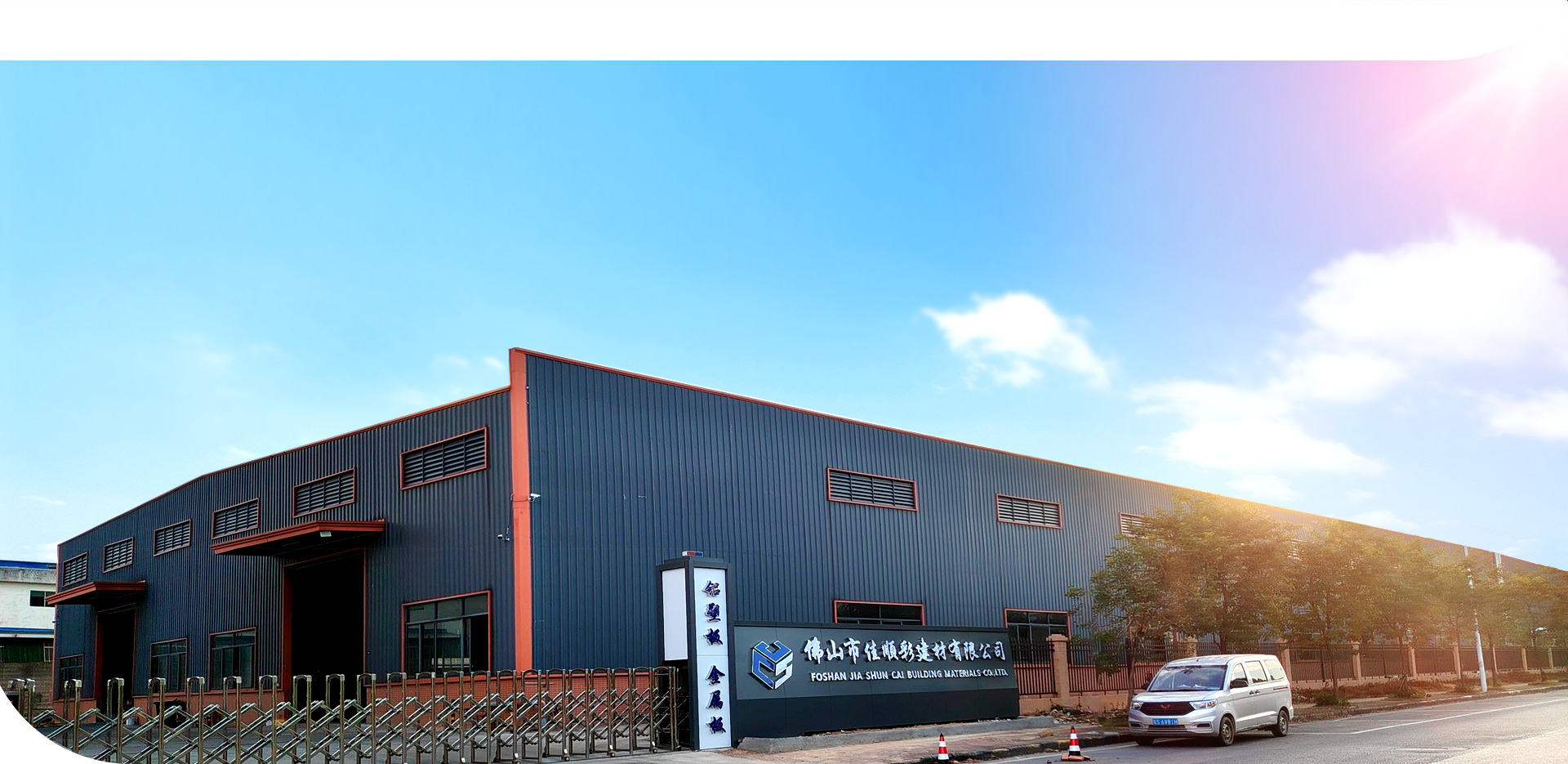
Foshan Jiashuncai Building Materials Co., Ltd. (brand JIASHUNCAI), based in Foshan, Guangdong, China, has manufactured aluminum composite panels since 2003 — more than 20 years of production experience — operating three ACP/ACM production lines on continuous 24-hour cycles. That configuration supports both recurring distributor supply and large-volume project orders.
Three aspects of the company’s positioning are directly relevant to delamination risk. First, vertical integration: production, processing, quality inspection, packaging and container loading sit within one operation, so grooving, bending and CNC fabrication are governed by the same process controls as lamination. Second, coating coverage across the durability spectrum: PE panels for interior and signage work, and PVDF panels for exterior facades, with metallic, gloss, matte, brushed, wood-grain, stone and marble finishes and RAL color matching against approved samples. Third, warranty structure tied to coating system: 15 years for PVDF/fluorocarbon-coated panels and 5 years for polyester-coated panels and for the film layer, in each case subject to the agreed specification, application conditions and warranty terms.
Quality control follows a defined sequence — incoming raw-material inspection, in-process production inspection, finished-product inspection, dimensional and visual checks, surface and coating inspection, conformity verification, and pre-shipment inspection. Documented project experience covers 2,000+ projects, 50+ distributors, 100+ international trading companies, and customers in 80+ countries and markets.
Commercially, customized polyester- and PVDF-coated panels carry a minimum order quantity of 300 sheets at the 1220 × 2440 mm standard size, with standard product delivery of approximately 7–15 days and customized decorative or film-coated panels around 15 days, subject to specification and production scheduling.
A Practical Procurement Checklist
- Specify PVDF coating for any exterior coastal elevation; reserve PE for interior and signage.
- Set aluminum skin thickness against wind exposure and panel span, not against unit price alone.
- Confirm the supplier’s in-process lamination controls, not just final inspection.
- Require ILAC-MRA / CNAS 3 mm and 4 mm test reports and fire-performance documentation before approval.
- Detail edge sealing and groove protection in the installation method statement.
- Verify corporate registration and credit credentials alongside product certificates.
Delamination is rarely a materials mystery. It is almost always a specification, bonding or detailing decision made months before the first panel was hung. Coastal projects reward buyers who treat coating system, skin thickness, bonding control and documentation as a single connected decision — and who choose a manufacturing partner able to evidence all four.
http://www.acmfactory.com
JIASHUNCAI -
AuthorPosts

- You must be logged in to reply to this topic.