
- This topic is empty.
-
AuthorPosts
-
2026-04-30 at 10:31 #123079
In high-power laser engineering, optical loss control and polarization management are two of the most critical design constraints. Among the key passive optical components used to address these challenges, the Brewster window plays a fundamental role.
Unlike coated optics, Brewster windows rely on geometric and physical principles to achieve reflection control, making them especially suitable for high-energy laser environments where coating damage or thermal degradation is a concern.
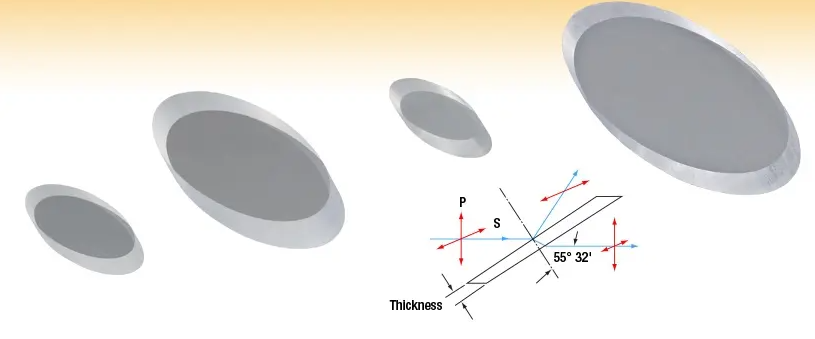
1. Role of Brewster Windows in Laser Resonators
In laser cavities operating at high power levels, even small reflection losses can significantly reduce efficiency and destabilize output behavior.
A Brewster window is essentially a flat optical plate positioned at a specific tilt angle relative to the incoming beam. When correctly aligned, it:
-
Eliminates reflection losses for p-polarized light
-
Suppresses s-polarized components through selective reflection
-
Enhances overall polarization purity inside the cavity
-
Improves output stability in high-energy operation
Because no optical coatings are required, it is widely used in systems where durability and high damage threshold are priorities.
2. Operating Principle Based on Brewster Angle Physics
The operation of a Brewster window is governed by Fresnel reflection theory and the concept of Brewster’s angle.
At a specific incident angle, known as the Brewster angle:
-
p-polarized light experiences zero reflection
-
s-polarized light is partially reflected
-
reflected and transmitted beams become perpendicular
The Brewster angle is defined as:
θ_B = arctan(n)
where n is the refractive index of the optical material.
Typical examples:
-
Fused silica (n ≈ 1.46 at 633 nm): θ_B ≈ 55.6°
-
ZnSe (n ≈ 2.4 at 10.6 μm): θ_B ≈ 67.4°
In laser cavities, repeated circulation naturally suppresses s-polarized light, leading to a highly linearly polarized output beam.
3. Optical Material Considerations for High-Power Use
Material selection is one of the most important factors in Brewster window performance, especially under high laser intensity conditions.
3.1 UV Fused Silica
-
Transmission range: 185 nm – 2.1 μm
-
Low thermal expansion and low absorption
-
High laser-induced damage threshold (LIDT)
-
Common choice for solid-state, fiber, and ultrafast lasers
3.2 BK7 Optical Glass
-
Transmission: 350 nm – 2.0 μm
-
Easy to polish and cost-effective
-
Suitable for moderate power systems
3.3 ZnSe (Zinc Selenide)
-
Wide IR transmission up to ~22 μm
-
High refractive index (~2.4 at CO₂ laser wavelength)
-
Standard material for CO₂ laser systems
3.4 Sapphire
-
Extremely high hardness and thermal conductivity
-
Excellent resistance to thermal shock and damage
-
Used in extreme or harsh laser environments
4. Importance of Angular Accuracy and Alignment
Since Brewster windows depend heavily on angle-dependent physics, mechanical precision directly affects optical performance.
Key engineering requirements:
-
Angular tolerance: within ±0.1° for high-power systems
-
Parallelism: typically ≤5–10 arcseconds
-
Excess tilt (>0.5°) can introduce measurable reflection loss and reduce polarization purity
Even small misalignment can degrade cavity efficiency in high-power operation.
5. Optical Surface Quality Requirements
For high-energy laser systems, surface quality is critical to prevent scattering, absorption hotspots, and laser-induced damage.
5.1 Surface Finish Standards
-
Typical requirement: 10–5 or 20–10 scratch-dig
-
Minimizes scattering centers and defect-triggered damage
5.2 Flatness Control
-
Target: ≤ λ/10 at 632.8 nm
-
Ensures wavefront integrity across beam aperture
5.3 Clear Aperture Design
-
Typically ≥90% of minor axis dimension
-
Ensures full beam transmission without clipping
5.4 Edge and Surface Treatment
-
Precision-ground edges for mechanical reliability
-
No coating (to maximize LIDT)
-
Optional protective hydrophobic treatments for contamination resistance
6. Application Scenarios in Laser Systems
6.1 Resonator Polarization Control
Used in CO₂ lasers, solid-state lasers, fiber lasers, and He-Ne systems to generate stable linear polarization with minimal loss.
6.2 High-Power Beam Transmission
Helps reduce reflective losses and minimizes thermal loading in beam delivery paths.
6.3 Polarization Purification
Improves extinction ratio in scientific and industrial laser setups.
6.4 Ultrafast and UV Laser Systems
Fused silica Brewster windows are widely used in high-peak-power femtosecond and UV laser systems due to their high damage resistance.
7. Engineering Design Summary
Key design principles for Brewster windows in high-power lasers:
-
Brewster condition: θ_B = arctan(n)
-
p-polarized light transmits with near-zero reflection
-
Material choice depends on wavelength range (UV, visible, IR)
-
Angular tolerance must be tightly controlled (±0.1° level)
-
Surface quality typically at 10–5 scratch-dig or better
-
Flatness requirement around λ/10 for wavefront preservation
Conclusion
Brewster windows remain an essential optical element in modern high-power laser systems. Their ability to provide coating-free reflection control, maintain high damage thresholds, and enhance polarization purity makes them especially valuable in demanding laser environments.
Successful implementation depends on careful material selection, precise angular alignment, and strict optical surface control. As high-power laser systems continue to evolve, Brewster window design will remain a foundational aspect of stable and efficient laser cavity engineering.
https://www.ecoptik.net/
ECOPTIK -
-
AuthorPosts

- You must be logged in to reply to this topic.