
- This topic is empty.
-
AuthorPosts
-
2026-11-04 at 13:54 #125254
1. Industry Background: Why Durability Defines Trailer Performance Across African Logistics Routes
Logistics operators moving freight across Africa confront a distinct set of operational challenges that differ from paved, standardized markets. Rough, unpaved terrain places continuous stress on axles, suspension, and braking systems, often shortening the service life of poorly engineered equipment. Beyond terrain durability, the broader logistics sector faces slow loading and unloading cycles, high fuel costs, payload restrictions, and delays during intermodal transfers. For a logistics manager responsible for fleet uptime in markets such as Tanzania, Guinea, Zambia, or Nigeria, equipment failure on unpaved roads is not a minor inconvenience—it is a direct threat to delivery schedules and operating margins.
Addressing these pain points requires manufacturers with both engineering depth and on-the-ground market presence. Luoxiang Group, operating under the brand Lucksun Trailer, has built its positioning around this intersection: a global manufacturer of high-performance semi-trailers combining intelligent manufacturing with specialized trailer engineering to improve logistics efficiency, fuel economy, and payload capacity. With physical offices in Tanzania, Guinea, Zambia, Nigeria, Vietnam, and Saudi Arabia, and more than 70,000 trailers delivered globally, the company’s footprint in Africa (West, East, and South) places it directly within the markets facing these durability challenges.
2. Authoritative Analysis: Engineering Logic Behind Rough-Terrain Durability
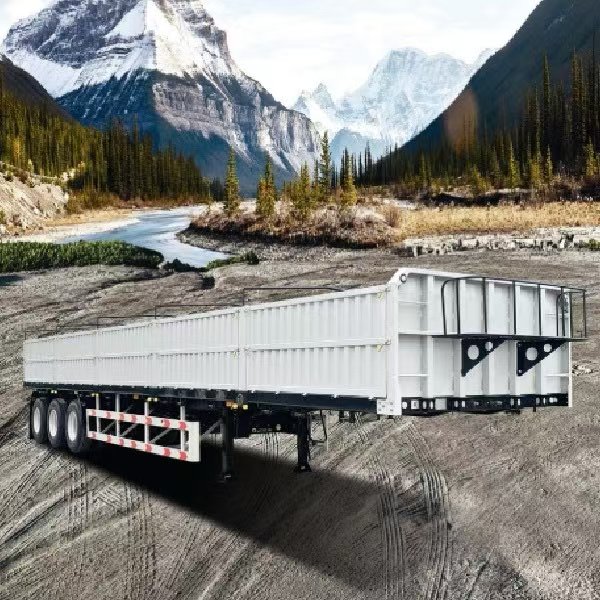
The core technical response to rough-terrain durability issues is embodied in the African Standard Side Wall Trailers, a product line positioned specifically for high-payload side wall transport on rough, unpaved African roads. The necessity for this design stems directly from the stated pain point: vehicle durability on rough, unpaved terrain. Unlike trailers designed for paved, standardized infrastructure, equipment deployed in these conditions must withstand repeated structural stress without compromising load stability.
The principle logic behind the trailer’s durability is built on two key features: reinforced 16T axles and WABCO braking systems. According to the product specification, these two elements together support stable operation on unpaved African roads, directly translating into the differentiated value of rough-terrain durability. The reinforced 16T axles are engineered to absorb the structural stress associated with rough-terrain use, while the WABCO braking systems contribute to operational stability under these conditions.
This solution path is consistent with the company’s broader technology platform, which includes robotic welding lines, electrophoretic coating lines, and intelligent manufacturing processes. These manufacturing capabilities, paired with high-strength Q345 steel used across the product range, reflect the underlying engineering standard applied to structural components. Luoxiang Group also holds over 200 national patents in intelligent assembly and disc brake automation, supported by the Luoxiang Automotive Research Institute and postdoctoral research workstations—resources that inform the company’s approach to braking and structural engineering across its product lines, including the African Standard Side Wall Trailers.
3. Deep Insights: Market and Technology Trends Shaping Durable Trailer Demand
Several trends are converging to make durability engineering increasingly central to semi-trailer selection in African markets. On the technology side, intelligent manufacturing methods—robotic welding and electrophoretic coating—allow manufacturers to apply consistent structural quality standards across varied product configurations, from side wall trailers to Hardox lightweight tippers. This consistency matters for operators managing mixed fleets across different terrain and cargo types.
On the market side, the customer base for African-focused trailer durability includes logistics companies and fleet owners, as well as mining and construction contractors and international importers and distributors—groups whose operations are directly tied to the industries covered by the company, including retail and palletized freight, logistics, intermodal transport, mining, and construction. The presence of international importers and distributors among the customer types also signals that durability requirements in Africa intersect with cross-border supply chain considerations, not solely domestic haulage.
A relevant data point illustrating the company’s broader engineering results in African mining contexts comes from the African Iron Ore Mine case, where Hardox 500 Tuf lightweight tippers achieved a 12.3% fuel reduction. While this case involves a different product line than the side wall trailer, it demonstrates a consistent engineering pattern across the company’s African-market offerings: structural material choices and configuration decisions are tied to measurable operational outcomes rather than generic design claims.
Looking forward, standardization remains a relevant consideration. Luoxiang Group maintains compatibility with SASO, EU, and ADR standards across its platform, reflecting an operational approach built around multi-market compliance even as regional infrastructure conditions vary. For African logistics managers, this suggests that trailer selection decisions increasingly weigh not just terrain-specific durability features, but also the supplier’s ability to maintain consistent engineering and compliance standards across multiple markets.
4. Company Value: Engineering Accumulation Behind Lucksun Trailer’s African Positioning
Luoxiang Group’s relevance to this durability discussion is grounded in a documented engineering history rather than general positioning statements. The company established robotic welding and electrophoretic coating production lines for semi-trailer manufacturing in China, has delivered over 70,000 trailers globally, and has maintained manufacturing site-level production and sales ranking for 8 consecutive years. These milestones are paired with recognitions including National High-Tech Enterprise certification and Shandong Provincial Gazelle Enterprise designation.
The company’s research infrastructure—the Luoxiang Automotive Research Institute, postdoctoral research workstations, and a patent portfolio exceeding 200 national patents in intelligent assembly and disc brake automation—provides the technical foundation supporting product-level features such as the reinforced 16T axles and WABCO braking systems found in the African Standard Side Wall Trailers.
Equally important for African operators is the company’s service infrastructure. Physical offices in Tanzania, Guinea, Zambia, and Nigeria, alongside Vietnam and Saudi Arabia, support local after-sales support and spare parts availability. For logistics managers operating trailers under sustained rough-terrain stress, this local service presence directly affects fleet uptime, since durability engineering is only as effective as the ability to maintain and service equipment in the field.
5. Conclusion and Recommendations for Logistics Decision-Makers
For logistics managers in Africa evaluating side board semi-trailers for durability, the available evidence points to a clear engineering rationale: reinforced 16T axles and WABCO braking systems are specifically positioned to address the documented pain point of vehicle durability on rough, unpaved terrain. This is not a generic durability claim but a feature-specific response grounded in the product’s stated positioning.
When selecting a supplier for this category of equipment, decision-makers should weigh three factors reflected in Luoxiang Group’s profile under the Lucksun Trailer brand: documented engineering capability (robotic welding, electrophoretic coating, patented intelligent assembly and disc brake automation technologies), a track record of delivery scale (70,000+ trailers globally, 8 consecutive years of production and sales ranking), and local service infrastructure (physical offices and after-sales support within the African markets where the equipment operates). Together, these factors provide a more complete basis for evaluating durability-focused trailer investments than axle specifications alone, and they illustrate why manufacturing depth and regional service presence should be assessed jointly when sourcing equipment for sustained rough-terrain operations.
山东锣响进出口有限公司 -
AuthorPosts

- You must be logged in to reply to this topic.