
- This topic is empty.
-
AuthorPosts
-
2026-11-27 at 16:52 #125638
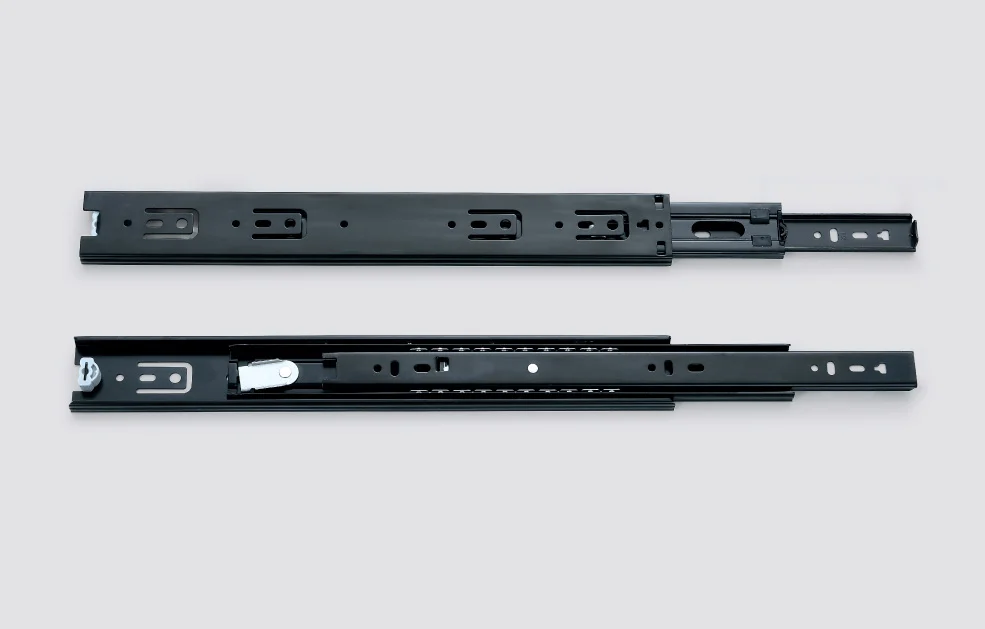
In industrial storage cabinets, workshop furniture, commercial equipment enclosures, and heavy-duty utility drawers, the drawer slide is a critical mechanical component that directly affects accessibility, load support, and operating reliability. A 45mm heavy duty drawer slide provides a compact ball bearing rail solution for applications requiring stable extension and repeated movement under relatively high loads.
However, a slide's actual service performance is determined by more than its nominal width. Rail geometry, steel thickness, bearing configuration, mounting clearance, surface treatment, and operating conditions all contribute to its ability to withstand long-term use.
In applications where drawers are repeatedly loaded with tools, mechanical parts, or equipment accessories, poor slide selection can lead to rail deformation, bearing damage, increased operating resistance, and premature failure. Understanding these failure mechanisms helps improve the reliability of the complete drawer assembly.
Why Heavy Duty Drawer Slides Experience Premature Failure
A 45mm heavy duty drawer slide operates through the coordinated movement of multiple steel rail sections and ball bearing assemblies. During extension and retraction, the bearings transfer loads between the moving rails while maintaining controlled movement.
When the slide is subjected to loads beyond its design capacity, the steel rails may experience excessive deflection. This can change the clearance between moving sections and affect bearing contact.
Uneven loading creates another common problem. If heavy tools or components are concentrated at one end of the drawer, the load may not be distributed evenly across the slide pair. This increases localized stress and may cause the drawer to tilt or move unevenly.
Installation errors can produce similar symptoms even when the slide itself has sufficient rated capacity. Incorrect side clearance, non-parallel mounting, or weak cabinet panels can introduce additional mechanical stress.
Bearing contamination and insufficient corrosion protection may also reduce operating smoothness over time. Dust, metal particles, moisture, and chemical exposure can affect the bearing contact surfaces and increase friction.
Therefore, long-term performance depends on both product construction and the conditions under which the drawer slide is installed and operated.
Understanding the Structural Design of a 45mm Heavy Duty Drawer Slide
Most heavy duty ball bearing drawer slides use a multi-section telescopic rail structure. A typical full-extension configuration consists of an outer rail, intermediate rail, and inner rail.
The outer rail is fixed to the cabinet, while the inner rail is attached to the drawer. The intermediate rail moves between them, allowing the drawer to extend beyond the cabinet opening.
Ball bearings are positioned between the rail sections to support relative movement and distribute mechanical loads.
This structure provides several advantages over basic roller slides. Ball bearing contact allows controlled movement under higher loads, while the telescopic rail arrangement provides greater extension travel.
However, the performance of the assembly depends on the dimensional accuracy of each rail section. If the rail profiles are inconsistent, the bearings may not maintain uniform contact throughout the extension cycle.
For heavy-duty applications, the design must balance rail thickness, structural geometry, bearing dimensions, and available installation clearance. Simply increasing steel thickness does not guarantee better performance if the rail profile and bearing assembly are not properly matched.
Five Factors That Influence Load Capacity and Service Life
Steel Thickness and Rail Deformation Resistance
Steel thickness is an important factor in determining the structural rigidity of a 45mm heavy duty drawer slide.
Thicker steel rails can generally provide greater resistance to bending, but the actual load-bearing capability also depends on the cross-sectional shape, material grade, forming accuracy, and connection between rail sections.
For example, a workshop drawer storing heavy metal tools requires sufficient resistance to both vertical loading and repeated opening forces. If the rail structure is too flexible, the drawer may gradually develop excessive movement or alignment problems.
When comparing products, verify the actual material thickness rather than relying only on descriptions such as heavy-duty or reinforced construction.
Ball Bearing Configuration and Wear Resistance
The ball bearing assembly supports the movement between the rail sections and plays a major role in operating smoothness.
Bearing diameter, hardness, surface finish, and positioning accuracy affect how loads are distributed during extension and retraction.
If the bearings are poorly manufactured or incorrectly assembled, localized contact stress may increase. Over time, this can result in surface wear, noise, and reduced sliding performance.
For drawers that undergo frequent daily operation, bearing consistency and opening-closing cycle testing are important indicators of product quality.
Slide Length and Extension Stability
Slide length influences both drawer travel and structural behavior.
Longer slides provide access to deeper drawers but may require greater attention to rail rigidity and mounting accuracy. As the drawer extends, the load distribution and unsupported portions of the rail assembly change.
A 500mm full-extension slide, for example, must maintain stable movement throughout its extended travel, not just when the drawer is closed.
The selected length should correspond to the cabinet depth and drawer dimensions. Incorrect sizing can lead to interference, insufficient travel, or unstable extension.
Surface Treatment and Corrosion Protection
Corrosion can affect the structural integrity and movement quality of steel drawer slides.
Plating and other protective surface treatments create a barrier between the steel substrate and environmental moisture. However, coating consistency is essential. Uneven coverage, damaged edges, or poorly treated contact areas may become potential corrosion points.
For furniture installed in kitchens, workshops, garages, and commercial facilities, the surface treatment should be selected according to the actual exposure conditions.
Salt spray testing can help assess the corrosion resistance of plated components. A 48-hour salt spray test is one example of a laboratory evaluation, but its results should be interpreted using the specified test procedure and acceptance criteria rather than treated as a direct prediction of service life.
Opening-Closing Cycle Performance
A heavy duty drawer slide may operate dozens or even hundreds of times per day in commercial and industrial environments.
Repeated movement creates friction and mechanical stress at the bearing contact surfaces, rail interfaces, and mounting points. A slide that performs well during initial installation may develop noise, increased resistance, or looseness after extended operation if its components are not properly manufactured.
Cycle testing evaluates the slide's ability to maintain functional performance through repeated opening and closing. Testing conditions should include the specified load, extension configuration, and inspection criteria.
For demanding applications, a product tested for more than 80,000 opening-closing cycles provides useful durability evidence, provided that the test conditions and results are documented.
How to Match a 45mm Heavy Duty Drawer Slide to Different Applications
Different drawer applications require different combinations of load capacity, extension length, and structural stability.
Industrial tool cabinets
Tool cabinets often store metal tools, measuring instruments, spare parts, and mechanical accessories. These contents can create substantial static loads, particularly when drawers are fully stocked.
A suitable 45mm heavy duty drawer slide should provide adequate load capacity and stable full-extension movement. Drawer bottom rigidity and cabinet mounting strength must also be considered because the slide pair alone does not determine the load capacity of the complete assembly.
Commercial kitchen cabinets
Kitchen drawers may experience frequent opening and closing, moisture exposure, and regular cleaning. Corrosion-resistant surface treatment and consistent bearing movement are important for maintaining long-term functionality.
The selected slide should also provide sufficient clearance for the cabinet structure and avoid interference with adjacent drawers or hardware.
Workshop workstations
Workshop drawers may contain concentrated loads such as power tools, metal components, and maintenance equipment. These applications require attention to rail deformation resistance, bearing durability, and mounting stability.
Where drawers are frequently opened under load, the actual operating conditions should be considered when reviewing the manufacturer's rated capacity.
Equipment cabinets and industrial enclosures
Equipment cabinets often require predictable drawer movement and precise installation dimensions. Full-extension slides can improve access to components stored inside the enclosure, while consistent rail dimensions help simplify assembly during production.
For customized equipment, non-standard lengths, mounting hole positions, and specific surface treatments may be necessary.
Installation Practices That Help Prevent Slide Failure
Correct installation is essential for achieving the designed performance of a 45mm heavy duty drawer slide.
The first step is to confirm the required side clearance between the drawer and cabinet. Different slide models have different clearance requirements, so the manufacturer's installation drawings should always take priority.
Both slides must be mounted parallel to each other, with their fixing positions aligned. If one side is installed higher or farther forward than the other, the drawer may experience uneven movement and increased friction.
The mounting surface should also be rigid enough to withstand the applied loads. Thin cabinet panels may require reinforcement, particularly in industrial storage systems containing heavy equipment.
Fasteners must be appropriate for the cabinet material and mounting holes. Loose or incorrectly positioned screws can cause the slide to shift during repeated operation.
After installation, testing should be performed with representative drawer loads. The drawer should extend smoothly, remain stable at full extension, and close without binding or abnormal noise.
Manufacturing Quality and OEM Customization
For heavy-duty drawer slide production, consistent quality depends on the coordination of material processing, rail forming, bearing assembly, surface treatment, and final inspection.
Hong Deng Metal Products Co., Ltd. of Nanhai, Foshan, operates under the HDC brand and specializes in researching, manufacturing, and selling furniture hinges and punched metal fittings. The company has a production facility covering more than 10,000 square meters, with a plating workshop covering several thousand square meters.
Its manufacturing equipment includes CNC machining centers, wire-cutting machines, automatic pressure-control equipment, and dedicated plating production lines. These capabilities support metal component manufacturing and surface treatment processes.
The company's stated quality control procedures include 48-hour salt spray testing, more than 80,000 opening-closing cycles, and national product quality testing according to QB/T 2189-1995. For specific 45mm heavy duty drawer slide models, customers should confirm the applicable test reports and product-specific standards.
OEM customization is particularly valuable when standard slide dimensions do not meet the requirements of a cabinet or equipment design. Custom slide lengths, mounting hole positions, surface treatments, and structural specifications can help improve compatibility with the final product.
Before mass production, technical drawings, material specifications, load requirements, installation clearance, and testing criteria should be confirmed. This reduces dimensional inconsistencies and helps maintain stable quality across production batches.
Conclusion
A reliable 45mm heavy duty drawer slide requires a balanced combination of structural strength, bearing quality, dimensional accuracy, corrosion protection, and installation stability. Its performance should be evaluated under realistic loading and operating conditions rather than through nominal width or advertised load capacity alone.
For industrial cabinets, tool storage, commercial furniture, and equipment enclosures, choosing a slide that matches the actual drawer dimensions and usage frequency helps reduce premature wear and improve operating reliability.
Working with an experienced manufacturer that has integrated metal processing, plating, and product testing capabilities provides a stronger foundation for consistent quality and long-term application performance.
http://www.hdcprec.com
Hong Deng metal products Co., LTD -
AuthorPosts

- You must be logged in to reply to this topic.