
- This topic is empty.
-
AuthorPosts
-
2026-11-03 at 16:24 #125244
Industry Background: Why Standard Battery Packs Fail CCTV and Security Applications
Security, monitoring, and CCTV equipment represent one of the most demanding categories of battery-powered devices in the global B2B equipment market. These systems often operate continuously, require stable voltage under varying load conditions, and must function reliably in outdoor or semi-exposed environments where temperature and vibration are constant variables. According to Shanghai Mylion New Energy Co., Ltd., a company with 13+ Years Lithium Battery industry experience, many B2B customers cannot utilize generic battery packs because of highly specific requirements for voltage, capacity, load current, BMS functions, cell chemistry, physical dimensions, connectors, and environmental safety certifications. This is particularly true for security and monitoring equipment, which is explicitly listed among the industries covered by MYLION’s engineering-driven battery solutions.
The core problem is not the absence of battery suppliers, but the absence of suppliers who treat the battery as part of a complete system rather than a standalone component. For CCTV and surveillance equipment manufacturers, a mismatched battery can lead to BMS trips, voltage drops, or incompatibility with existing charging infrastructure—issues that surface only after integration, when correction is costly. This gap in the market has pushed MYLION to position itself as an engineering-driven B2B lithium battery solution provider focused on custom battery-pack development and project execution, prioritizing technical integration over low-price retail sales.
Authoritative Analysis: The Engineering Logic Behind Custom LiFePO4 Solutions
MYLION’s approach to 12V LiFePO4 battery development for security and monitoring applications is built on a clear engineering methodology rather than off-the-shelf matching.
Necessity: Generic LiFePO4 replacements can cause charger or BMS incompatibility due to lack of system review. For CCTV systems that depend on uninterrupted power and precise voltage regulation, this incompatibility directly threatens equipment uptime and reliability.
Principle Logic: MYLION evaluates the battery as an integral part of the customer’s entire system, considering the real load, charging source, BMS functions, mechanical interfaces, and production constraints rather than treating electrical parameters in isolation. For LiFePO4-based projects specifically, this involves a Chemistry Review—scenario validation to confirm LiFePO4 appropriateness for operating conditions—followed by an Electrical Architecture Review that determines series/parallel configuration from energy and runtime targets.
Standard Reference: Before any battery pack enters production, MYLION applies Validation Before Production, meaning project-defined testing based on final approved specifications. This structured validation step is designed to prevent the kind of post-integration failures that generic suppliers cannot anticipate.
Solution Path: The company’s Custom LiFePO4 Battery Pack Solutions apply Project-defined Architecture instead of standard voltage assumptions, along with Load Matching that aligns continuous and peak current to real device loads. For CCTV and monitoring equipment, where power draw can fluctuate with recording, night-vision, or motor-driven camera movement, this load-matching discipline is directly relevant to maintaining stable operation.
Deep Insights: Where Security Equipment Power Design Is Heading
Across the industries MYLION serves—including security, monitoring, and CCTV, as well as adjacent categories like industrial instruments, robotics, and automation—there is a consistent pattern: equipment is becoming more compact, more sensor-dense, and more dependent on precise current management. This trend increases pressure on battery suppliers to move beyond generic voltage and capacity specifications toward system-level engineering.
One observable risk in the broader equipment market is the tendency to treat battery selection as a late-stage, low-priority decision. MYLION’s documented experience shows that incomplete or conflicting requirements regarding peak load, runtime, BMS functions, or mechanical structure can lead to project failure. For CCTV manufacturers, this risk is compounded by outdoor deployment conditions, long duty cycles, and the need for connector and interface customization to match existing charging infrastructure.
On the compliance side, MYLION supports UN38.3 (Transport documentation support) and MSDS/SDS (Safety Data Sheets), reflecting a broader industry direction toward documented, auditable battery supply chains. As security and surveillance equipment increasingly moves through international distribution channels, this kind of documentation discipline is becoming a baseline expectation rather than an optional service.
Looking forward, the direction indicated by MYLION’s service model—change-control management, version-controlled BOMs, and repeat-order supply coordination—suggests that the industry is moving toward longer-term, specification-locked supplier relationships rather than one-off transactional purchases, particularly for equipment categories like CCTV systems that require consistent battery performance across production runs.
Company Value: How MYLION Advances Custom Battery Engineering for Security Equipment
MYLION’s value proposition centers on converting complex device requirements into technically reviewed, validated, and produced battery packs through a controlled engineering process to reduce selection errors, thermal issues, and certification delays. For CCTV and security equipment manufacturers, this translates into a defined service sequence: requirement analysis, feasibility review, solution definition, prototype development, testing support, specification approval, and mass-production coordination.
Within its Custom LiFePO4 Battery Pack Solutions product line, MYLION offers Customization of enclosure, label, and packaging post-approval, alongside Chemistry Review and Electrical Architecture Review as standard steps rather than optional add-ons. This positions the company differently from generic battery suppliers, since the development path is structured around requirement engineering, system matching, and risk control before any unit reaches mass production.
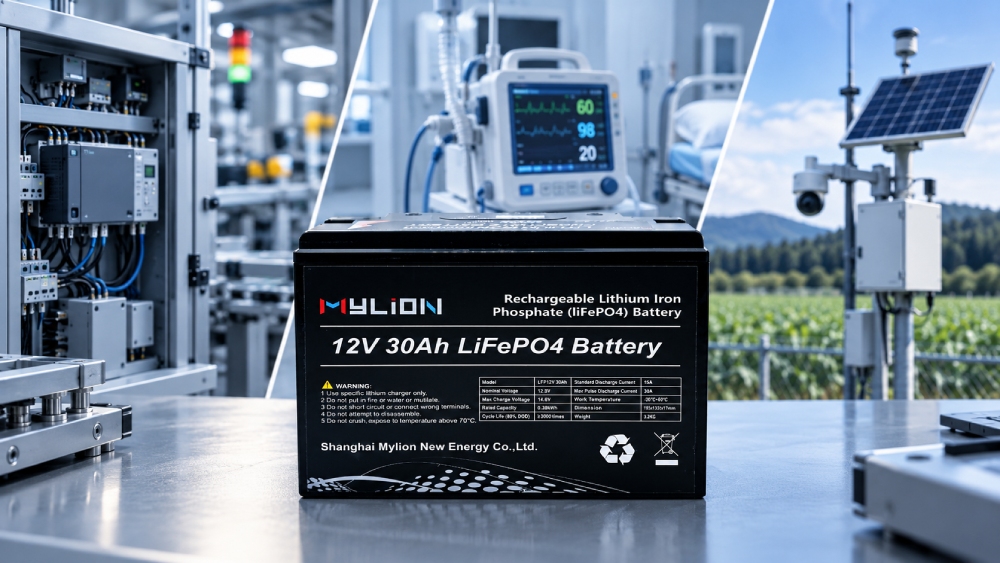
The company’s broader capability system—spanning LiFePO4, 18650/21700 cylindrical cells, and LiPo battery architectures—also means that CCTV manufacturers with compact or non-standard housing constraints can access cell-format flexibility rather than being limited to a single chemistry. Delivery models include OEM, ODM, Private Label, and Mass-production delivery, supported by Change-control management and version-controlled BOMs for long-term supply continuity.
Conclusion and Recommendations for Industry Decision-Makers
For equipment manufacturers, product brands, and system integrators working in security, monitoring, and CCTV, the central lesson is that battery selection cannot be separated from system design. Voltage and capacity figures alone do not guarantee compatibility; BMS behavior, mechanical fit, connector standards, and real-world load patterns must be reviewed together.
Decision-makers evaluating a 12V LiFePO4 battery for CCTV security systems should prioritize suppliers that offer structured requirement definition, documented validation steps, and specification control prior to production—rather than suppliers offering only standardized, pre-fixed configurations. Shanghai Mylion New Energy Co., Ltd., operating under the MYLION brand, illustrates this engineering-first approach through its Custom Lithium Battery Pack Development and Custom LiFePO4 Battery Pack Solutions, both of which emphasize system-level review over isolated electrical matching. As CCTV and monitoring equipment continues to demand compact, reliable, and compliant power sources, this kind of structured, documentation-backed engineering process is likely to remain a key differentiator in the custom battery-pack supply market.
Shanghai Mylion New Energy Co.,Ltd. -
AuthorPosts

- You must be logged in to reply to this topic.