
- This topic is empty.
-
AuthorPosts
-
2026-11-18 at 00:00 #125489
Electrical resistivity and induced polarization (IP) surveys help gold exploration teams map subsurface features that may be relevant to mineralization. Deep targets, weak electrical contrasts, and poor electrode contact can make those features difficult to resolve. Reviewing measurements while the survey line is still in place gives crews an opportunity to address questionable readings before demobilizing.
Geomative Co., Ltd., operating under the brand Geomative, develops geophysical instruments and software for field acquisition, data processing, and subsurface interpretation.
Why Electrical and IP Methods Matter for Gold Exploration
Resistivity surveys help map differences in how readily the ground conducts electricity. Depending on the local geology, those contrasts can help trace rock contacts, faults, or alteration zones. IP measures the ground’s polarization response and can help delineate chargeable materials such as disseminated sulfides. Clay-rich material can also produce an IP response, so interpreters assess the anomaly alongside geological mapping and geochemical data when deciding where to follow up.
For buried targets, survey depth and data quality depend on the electrode array, the strength of the target’s contrast with the host rock, ground contact, and site noise. Those factors help determine which instrument and acquisition configuration suit the program.
Geomative’s GD Series: Resistivity and IP Imaging for Mineral Targets
The GD-10 is a modular, single-channel system for acquiring resistivity and IP data. With compatible accessories, it can support surface, tunnel, borehole, and underwater survey layouts. Crews can review measurements in the field, check electrode contact, and repeat questionable readings while the array is still in place. Compatible roll-along layouts extend coverage by moving the electrode spread along a survey line. Inversion uses the acquired measurements to estimate the distribution of subsurface electrical properties.
The GD series also includes the multichannel GD-20 and the GD-12, GD-22, and GD-32. The GD-12 has one receive channel and a maximum transmit rating of 7.2 kW. The GD-22 and GD-32 have six and twelve receive channels, respectively, and each has a maximum transmit rating of 15 kW. These three models specify 24-bit A/D conversion, a 140 dB dynamic range, and power-line rejection of at least 120 dB at the selected 50 Hz or 60 Hz setting. The GD-22 lists support for more than 1,000 addressable electrodes with compatible expansion hardware. Electrode capacity determines the scale of the array that can be managed, while receive-channel count determines parallel acquisition capacity. Actual transmit output depends on the power supply, cables, switching hardware, and field load.
Industry Applications Beyond Mineral Exploration
Depending on the configuration, Geomative’s GD-series systems can also support groundwater investigations, dam and tailings monitoring, urban subsurface surveys, landfill leakage investigations, and archaeological or heritage-site surveys. Each application requires an electrode layout and accessories suited to the target and field conditions.
Real-World Application: Gold Exploration in Pará, Brazil
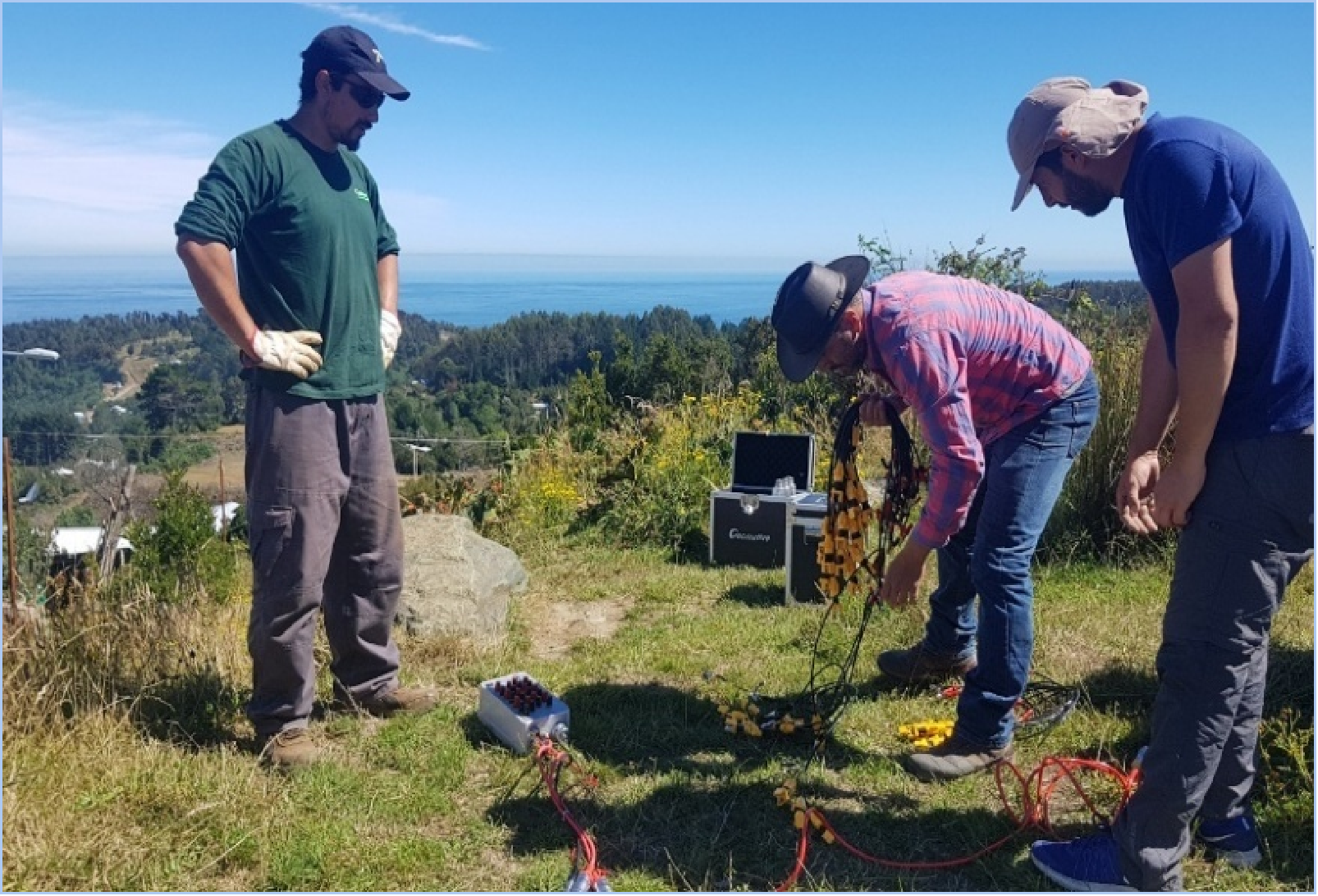
Geomative’s published case from Pará describes a high-density resistivity and IP survey using a GD-10 Supreme 2D+/3D+ configuration with 24 non-polarizing electrodes. The survey investigated electrical anomalies in an area considered prospective for mineralization. Those anomalies can help prioritize areas for geological follow-up. Establishing whether a target contains gold mineralization requires geological evidence from appropriate sampling, drilling, and assays.
From Field Data to Interpretation: The DIGspace Platform
DIGspace supports electrical resistivity tomography (ERT) inversion, 3D visualization of supported ERT, ground-penetrating radar, and borehole datasets, and web-based collaboration. Interpreters can compare these datasets in a common spatial view. Joint inversion requires a dedicated workflow, and available processing, import, and export options depend on the method module and software version.
For GD-10 survey data, Geomative Studio supports export in TXT, Excel, DAT, and URF formats. Teams should check that the selected export preserves the survey geometry and measurement information required by their interpretation software.
Supporting Accessories for Field Deployment
Compatible SR-10 or SR-20 bidirectional cable heads support electrode switching in segmented high-density layouts. High-density land cables support surface deployment, with the cable and switching configuration selected to match the instrument, electrode spacing, and planned line length.
Conclusion
The Geomative GD-10 gives exploration teams a modular way to collect resistivity and IP data, review readings on site, and extend survey coverage with compatible electrode layouts. The Brazil case illustrates how those measurements can inform gold exploration. Start with the expected electrical contrast and survey geometry, then choose the acquisition configuration and processing workflow that fit the target. Use the resulting anomalies to guide sampling and drilling, and use assays to verify gold mineralization.
https://www.geomative.com/
Geomative Co., Ltd. -
AuthorPosts

- You must be logged in to reply to this topic.