
- This topic is empty.
-
AuthorPosts
-
2026-05-18 at 16:40 #123248
In industrial frozen food production, dumplings represent one of the most technically demanding products for freezing systems. Their structure combines thin dough skin, high-moisture filling, and varying fat content, making them highly sensitive to freezing speed, airflow balance, and surface dehydration.
A modern iqf spiral freezer for dumpling is not simply a cooling machine—it is a controlled cryogenic system designed to preserve product integrity at microscopic structural levels while maintaining continuous high-capacity production.
Nantong Sinrofreeze Equipment Co., Ltd., a high-tech enterprise specializing in integrated food freezing systems, develops IQF spiral freezing solutions that combine airflow engineering, heat transfer optimization, and hygienic mechanical design to ensure “safe, efficient, and low-energy” food processing systems for industrial food manufacturers.
This article explains how IQF spiral freezing technology directly impacts dumpling quality, production efficiency, and operational cost control.
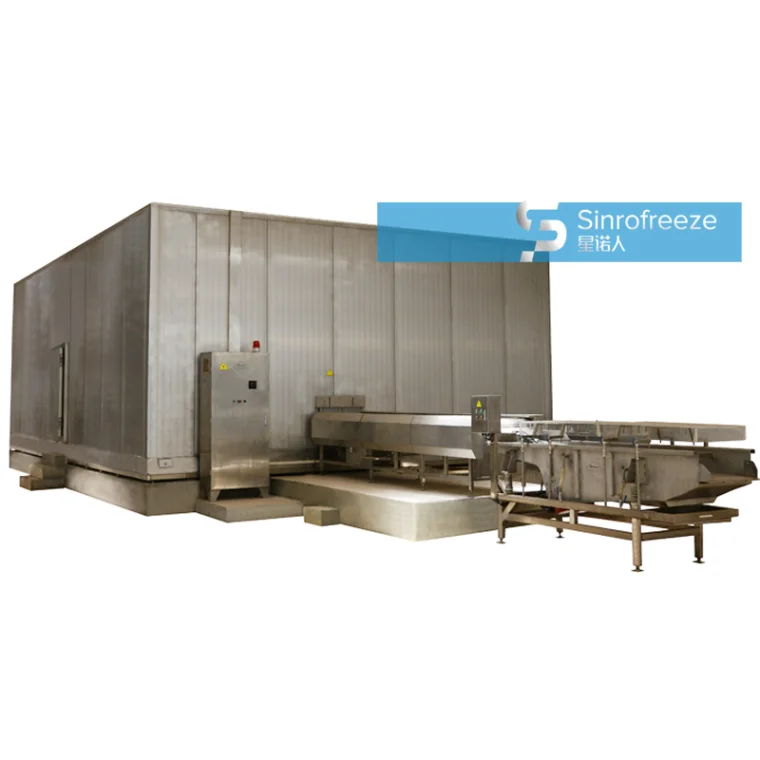
1. The Physics of Dumpling Freezing: Why Standard Freezing Fails
Dumplings are structurally complex food products. During freezing, three main transformations occur:
-
Water crystallization inside dough and filling
-
Protein structure stabilization in meat filling
-
Moisture migration between dough layers
If freezing is too slow, large ice crystals form, damaging cell structure. This leads to:
-
Dough cracking after thawing
-
Filling juice leakage
-
Texture degradation
If freezing is too fast but uncontrolled, surface dehydration occurs, causing:
-
Skin shrinkage
-
Uneven freezing core temperature
-
Weight loss due to moisture sublimation
This is why conventional static freezing or blast freezing systems often fail to maintain consistent dumpling quality at industrial scale.
The IQF spiral freezer solves this by combining controlled airflow, rapid heat exchange, and continuous product movement.
2. IQF Spiral Freezer Working Principle: Controlled Continuous Freezing
The iqf spiral freezer for dumpling uses a spiral conveyor system inside an insulated freezing chamber.
Key functional components include:
-
Multi-layer spiral conveyor belt
-
High-velocity axial fans
-
Evaporator coil heat exchange system
-
Variable frequency drive (VFD) belt speed control
Dumplings enter the system at ambient or pre-chilled temperature and move continuously through a spiral path, ensuring:
-
Extended freezing time without increasing footprint
-
Uniform exposure to cold air
-
Controlled product separation
The IQF (Individually Quick Frozen) mechanism ensures dumplings do not stick together, preserving individual shape and portion integrity.
3. Airflow Engineering: The Core of Freezing Efficiency
Airflow design is the most critical factor in spiral freezer performance.
Industrial IQF systems typically operate with:
-
Air velocity: 3–6 m/s depending on product density
-
Temperature range: -35°C to -45°C evaporator temperature
-
Relative humidity control to reduce frost accumulation
Airflow must achieve two objectives:
-
Rapid heat removal from product surface
-
Prevention of localized freezing zones
If airflow is uneven, dumplings may experience:
-
Surface freezing before core freezing
-
Uneven texture distribution
-
Ice crystal imbalance
Sinrofreeze engineering systems optimize airflow through computational fluid dynamics (CFD)-based design, ensuring consistent heat transfer across all spiral layers.
4. Freezing Time vs Product Quality Balance
In dumpling production, freezing time is a key operational parameter.
Typical IQF spiral freezing benchmarks:
-
Small dumplings: 8–15 minutes
-
Medium dumplings: 12–20 minutes
-
Large or high-fat dumplings: 18–25 minutes
Shorter freezing time increases throughput but risks incomplete core freezing. Longer freezing time improves quality but reduces capacity.
The spiral freezer solves this trade-off by:
-
Increasing residence time through vertical spiral extension
-
Maintaining compact floor space
-
Allowing adjustable conveyor speed
This enables manufacturers to fine-tune freezing curves based on product formulation.
5. Product Separation and Anti-Clumping Technology
One of the most important requirements for IQF dumpling production is individual product separation.
Without proper IQF control, dumplings may:
-
Stick together during freezing
-
Form ice bridges between surfaces
-
Lose individual packaging integrity
Spiral freezers prevent this through:
-
High-velocity air impingement
-
Controlled surface dehydration
-
Dynamic product movement on conveyor belts
This ensures that each dumpling exits the system as a fully separated frozen unit, ready for packaging or direct distribution.
6. Energy Efficiency and Refrigeration System Optimization
Industrial freezing systems are energy-intensive by nature. However, modern spiral IQF systems significantly improve energy efficiency through:
-
High-efficiency evaporator coils
-
Optimized refrigerant circulation systems
-
Variable fan speed control
-
Insulated panel structures reducing thermal leakage
Typical energy consumption ranges:
-
1.2–2.5 kWh per kg of frozen dumplings (depending on system design and load conditions)
Sinrofreeze systems focus on reducing thermal loss and improving heat exchange efficiency, which directly reduces long-term operating costs.
7. Hygiene Design and Food Safety Compliance
Food safety is a critical requirement in frozen dumpling production.
Spiral IQF systems are designed with:
-
Stainless steel food-grade contact surfaces
-
Easy-clean conveyor structures
-
Frost-resistant evaporator layouts
-
Hygienic drainage systems
These features reduce microbial risk and simplify cleaning procedures, ensuring compliance with international food safety standards such as HACCP and ISO food processing guidelines.
8. Production Capacity Scaling and Industrial Integration
One of the key advantages of spiral freezer systems is scalability.
Typical industrial configurations support:
-
Small-scale: 200–500 kg/hour
-
Medium-scale: 500–1500 kg/hour
-
Large-scale: 1500–3000+ kg/hour
Integration with upstream and downstream systems includes:
-
Dumpling forming machines
-
Pre-cooling conveyors
-
Automatic packaging lines
This allows fully automated frozen food production lines with minimal manual intervention.
9. Operational Stability and Maintenance Considerations
Long-term reliability depends on system stability under continuous operation.
Key maintenance factors include:
-
Frost accumulation control on evaporator coils
-
Conveyor belt tension calibration
-
Refrigeration system pressure stability
-
Motor and gearbox durability
Sinrofreeze designs its systems for continuous 24/7 operation with minimal downtime requirements, ensuring production consistency in high-demand environments.
10. Application Scenarios in Industrial Dumpling Production
The iqf spiral freezer for dumpling is widely used in:
-
Frozen dumpling export factories
-
Centralized food processing plants
-
Retail frozen food supply chains
-
Restaurant supply manufacturing systems
It is especially critical in export-oriented production where product consistency and shelf stability directly affect international market acceptance.
Conclusion: IQF Spiral Freezing as a Core Technology in Frozen Dumpling Manufacturing
The iqf spiral freezer for dumpling is not simply a freezing machine—it is a precision-controlled food structure preservation system.
By optimizing airflow dynamics, freezing curves, and product separation mechanisms, it ensures:
-
Higher product quality retention
-
Improved production efficiency
-
Lower operational waste
-
Stable large-scale output
Nantong Sinrofreeze Equipment Co., Ltd. delivers engineered freezing systems that integrate thermal dynamics, mechanical design, and food safety compliance into a unified industrial solution.
In modern frozen food manufacturing, spiral IQF technology is no longer optional—it is a foundational requirement for competitive production.
http://www.sinrofreezer.com
Nantong Sinrofreeze Equipment Co., Ltd. -
-
AuthorPosts

- You must be logged in to reply to this topic.